Massimo Luciani

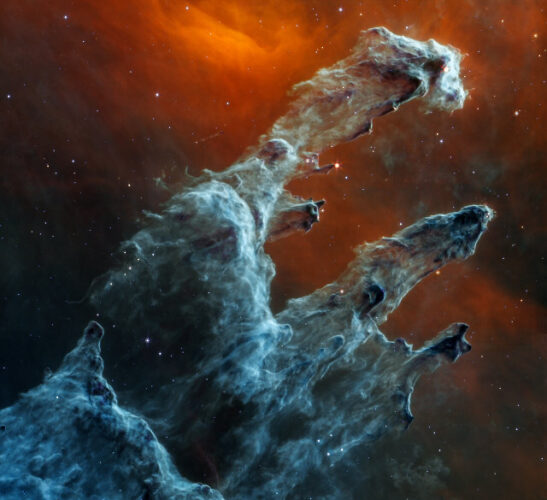
The Pillars of Creation as seen by the James Webb Space Telescope's MIRI instrument (Image NASA, ESA, CSA, STScI, J. DePasquale (STScI), A. Pagan (STScI))

A new image of the so-called Pillars of Creation was released, once again captured by the James Webb Space Telescope. It follows an image published a few days ago yet they show a landscape that looks very different with regards to the background of the structures that gave this star-forming area its nickname. This is due to the fact that this image was captured using the Mid-Infrared Instrument (MIRI), which sees in the mid-infrared, while the previous one was captured using the Near-Infrared Camera (NIRCam), which sees in the near-infrared. The different views offer a combination of information that is very useful in studying the gas and dust clouds in which there are young stars and others in the process of forming.

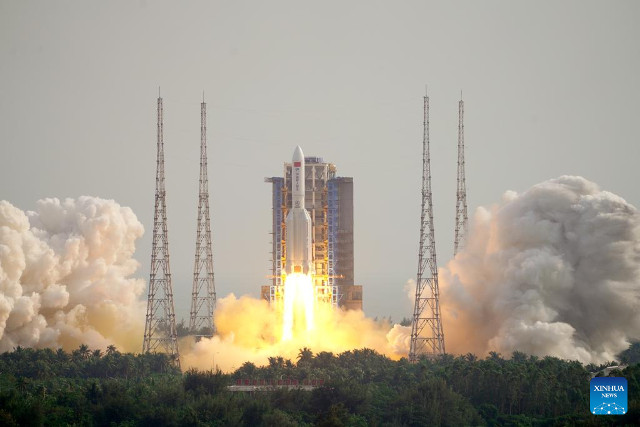
The Mengtian module blasting off on a Long March-5B rocket (Photo courtesy Xinhua/Guo Zhongzheng)

Confirmation arrived that the Mengtian module successfully completed docking maneuvers with the Chinese Tiangong space station’s Tianhe core module. Mengtian was launched about 13 hours earlier from the Wenchang base on a Long March-5B rocket. A few hours after docking, the Shenzhou-14 mission taikonauts, as the Chinese call their astronauts, entered the new module. This success represents the completion of the first phase of the Chinese space station construction, as now it’s formed by the core module Tianhe and two laboratories after the Wentian reached orbit on July 24.

The Progress MS-21 cargo spacecraft blasting off atop a Soyuz rocket (Image NASA TV)

A few hours ago, the Progress MS-21 spacecraft blasted off atop a Soyuz-2.1a rocket from the Baikonur Cosmodrome in Kazakhstan. After about nine minutes it successfully separated from the rocket’s last stage and was placed on its route. The cargo spacecraft began its resupply mission to the International Space Station also called Progress 82 or 82P. In this mission, the route used is the one that requires about two days.

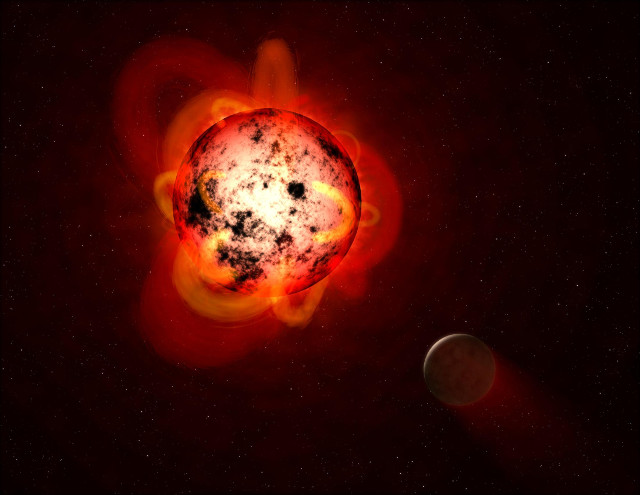
Artist's concept of a rocky planet's atmosphere being stripped by a red dwarf's flares

An article published in “The Astrophysical Journal Letters” reports a study on the exoplanet GJ 1252b which concludes that it has no atmosphere. In particular, a team of researchers used data collected by the Spitzer Space Telescope to examine this rocky planet which is about 20% larger than the Earth with a mass that is about 32% larger than the Earth’s. GJ 1252b orbits a red dwarf and according to the researchers, this star stripped this super-Earth’s atmosphere. This is due to the fact that red dwarfs are small but very active stars and confirms that it may be difficult to find a habitable planet around this type of star.