
Massimo Luciani

The Cartwheel galaxy seen by the James Webb Space Telescope (Image NASA, ESA, CSA, STScI)

An image captured by the James Webb Space Telescope shows the Cartwheel galaxy in greater detail than those obtained in the past with other telescopes. A combination of Webb’s NIRCam and MIR instruments allowed the identification of individual stars and star-forming regions while also offering new insights into the behavior of the supermassive black hole within this peculiar galaxy. This is a new help in the study of the changes taking place in what is most likely the consequence of a collision between two different galaxies with a transformation still taking place.

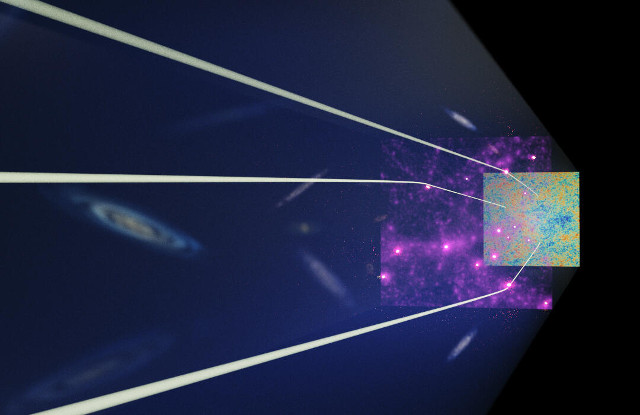
An artistic representation of the combination of the observations obtained in the HSC-SSP survey and the cosmic microwave background data collected by the Planck Surveyor space probe

An article published in the journal “Physical Review Letters” reports the results of an analysis of dark matter distribution around 1.5 million primordial galaxies. A team of researchers led by Hironao Miyatake of the Japanese University of Nagoya used observations conducted with the Subaru telescope and analyzed data collected by the Planck Surveyor space probe to detect distortion of the cosmic microwave background (CMB).

The results of this study show fluctuations in dark matter distribution in the early universe that led to inhomogeneity in the aggregation of ordinary matter that formed galaxies. That aggregation is lower than predicted by the Lambda-CDM model, the one that currently best describes the observations. The uncertainty lies in the difficulty of obtaining precise results in examining very distant galaxies.

A lunar pit in the Mare Tranquillitatis on the Moon

An article published in the journal “Geophysical Research Letters” reports a study on some lunar pits where temperatures are stable at around 17° Celsius (about 290 Kelvin). A team of researchers led by UCLA’s Tyler Horvath used detections conducted with NASA’s Lunar Reconnaissance Orbiter (LRO) space probe’s Diviner Lunar Radiometer Experiment, or simply Diviner, instrument and computer simulations to assess the conditions that exist in particular in lunar pits. The discoveries are interesting in the search for the best places on the Moon to build human habitats.

The runaway star Zeta Ophiuchi and its bow shock

An article accepted for publication in the journal “Astronomy and Astrophysics” reports a study on the star Zeta Ophiuchi, a so-called runaway star that became famous even beyond the field of astronomy for its bow shock, the enormous shock wave similar to the waves generated in the water by the bow of a ship. A team of researchers led by Samuel Green from the Institute for Advanced Studies in Dublin, Ireland, built detailed computer models of the bow shock to try to explain the observed data. The results confirm the origins of Zeta Ophiuchi but only partially explain the X-ray emissions detected.

The Wentian module blasting off atop a Long March-5B Y3 rocket (Photo courtesy Xinhua/Yang Guanyu)

A confirmation has arrived that the Wentian module has successfully completed its docking maneuvers with the Chinese Tiangong space station’s Tianhe core module. Wentian was launched about 13 hours earlier from the Wenchang base atop a Long March-5B Y3 rocket. A few hours after docking, the taikonauts, as the Chinese call their astronauts, of the Shenzhou-14 mission entered the new module. This is another crucial step in the construction of the Chinese space station.