Massimo Luciani

Webb's First Deep Field (Image NASA, ESA, CSA, and STScI)

NASA has released the first official images captured by the James Webb Space Telescope. The presentation was made in collaboration with ESA and CSA (Canadian Space Agency), the other space agencies that work together with NASA on the project and its management. Yesterday, when it was afternoon at the White House, US President Joe Biden personally presented the top image, Webb’s First Deep Field image that includes the SMACS 0723 galaxy cluster as a preview, a proof of the importance of this space telescope.

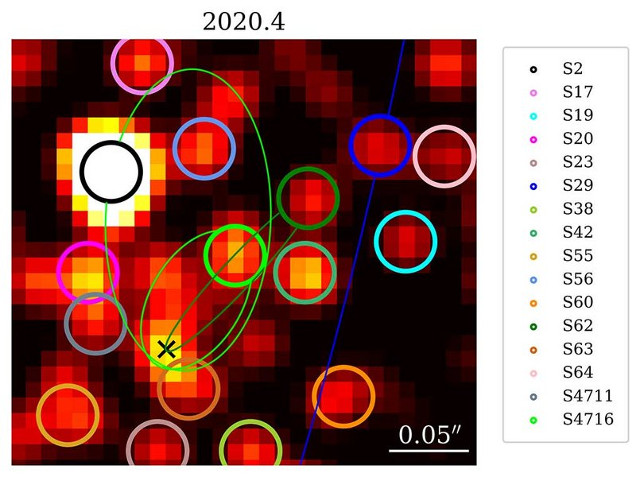
16 stars of the S cluster

An article published in “The Astrophysical Journal” reports the identification of the star with the closest orbit around Sagittarius A*, the supermassive black hole at the center of the Milky Way. A team of researchers cataloged it as S4716 after finding it in data collected over twenty years with the Keck Observatory, the VLT, and the VLTI. The star S4716 completes an orbit in about 4 Earth years and its distance from Sagittarius A* is as close as 100 times the Earth’s from the Sun. Its discovery, which breaks the record of the star S4711, is surprising and will help to better understand how stars in that area formed and moved, as it’s difficult to think that it formed this close to a supermassive black hole.

13.6 TeV collisions detected by the LHC ATLAS experiment (Image courtesy ATLAS Collaboration/CERN)

CERN announced that yesterday, when it was afternoon in Switzerland, the detectors of the Large Hadron Collider (LHC) began detecting collisions between particles at an energy that reached 13.6 TeV (Tera-electronVolts). These are energy levels never reached before, which mark the beginning of Run 3, the third LHC research campaign.

At the end of April, after the Long Shutdown 2, the period of more than three years in which the LHC equipment was updated, the slow restart of the largest particle accelerator in the world began. The detectors and other systems of the LHC experiments were updated as well to increase the quantity and quality of data that will be collected in the new research campaign.

The galaxy CGCG 396-2 (Image ESA/Hubble & NASA, W. Keel)

An image captured by the Hubble Space Telescope shows the galaxy CGCG 396-2, out of the ordinary thanks to its many arms. It’s a galaxy that has become an object of interest by the Galaxy Zoo project, one of the astronomical projects that involve the public, in this case, to classify galaxies observed by various telescopes. CGCG 396-2 was selected for follow-up observations with Hubble, whose ACS instrument made it possible to examine the arms that have an unusual configuration because there’s a galaxy merger taking place and consequently an unusual shape that is changing over time.

The ultra-faint dwarf galaxy Pegasus V

An article submitted for publication in the journal “Monthly Notices of the Royal Astronomical Society” reports the identification of an ultra-faint dwarf galaxy that was named Pegasus V near the Andromeda galaxy. A team of researchers conducted follow-up observations following the discovery made by an amateur astronomer and, using the GMOS instrument mounted on the Gemini North telescope in Hawaii, confirmed its existence. An interesting result of the observations is the very limited presence of elements heavier than hydrogen and helium, a discovery that led to the conclusion that it’s a kind of fossil of a primordial galaxy.