Astronomy / Astrophysics

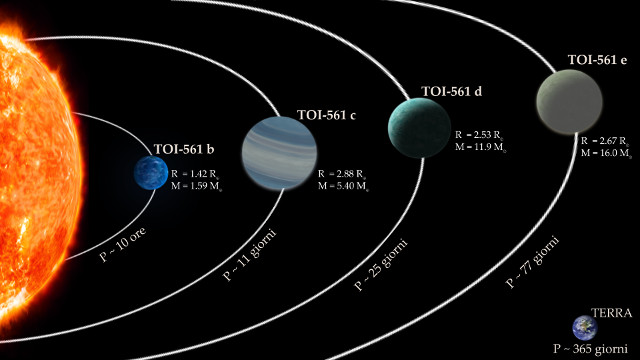
The TOI-561 system

An article published in the journal “Monthly Notices of the Royal Astronomical Society” reports a study on the planetary system of the star TOI-561, which includes a super-Earth and three mini-Neptune. A team of researchers used data from NASA’s TESS space telescope and follow-up research with the HARPS-N spectrograph mounted on the Galileo National Telescope (TNG) on the Canary Island of La Palma to distinguish the traces of the planets and to measure some of their characteristics.

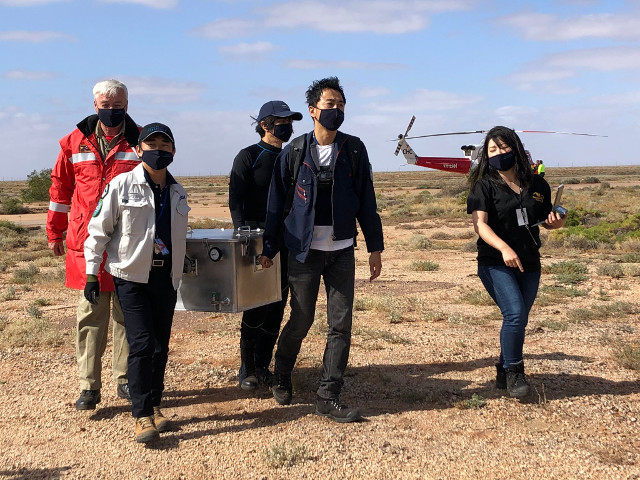
The samples from asteroid Ryugu after getting recovered (Photo courtesy JAXA. All rights reserved)

Yesterday, the Japanese space probe Hayabusa 2 released the capsule containing the samples taken from asteroid Ryugu to Earth. The capsule landed in Australia’s Woomera region. A few hours later, the space agency JAXA crew confirmed that they recovered the capsule and started preparations for its transport to the laboratory in Japan where it will be opened to start examining its contents.

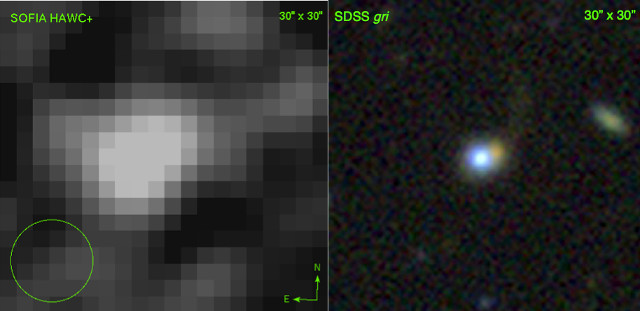
Views of galaxy CQ 4479

An article published in “The Astrophysical Journal” reports a study on the galaxy CQ 4479, where a quasar was observed, an active galactic nucleus with a supermassive black hole that is devouring large amounts of matter, and at the same time an intense star formation. A team of researchers used the SOFIA flying telescope to observe CQ 4479, and found this situation called a cold quasar because the active galactic nucleus is very hot but the galaxy also contains cold gas that gives birth to new stars. This is a rare case that could show an astronomically short period in the evolution of a galaxy before the quasar starts inhibiting star formation.

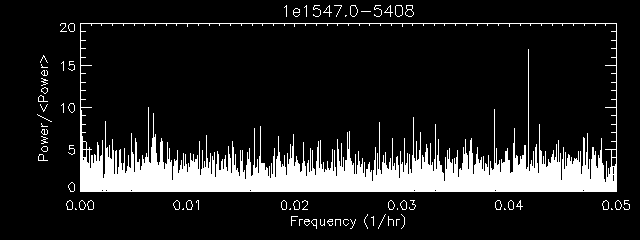
Emissions from 1e1547.0-5408

An article accepted for publication in “The Astrophysical Journal” reports a new analysis of observations conducted in 2009 of the magnetar cataloged as 1E1547.0-5408. A team of researchers led by GianLuca Israel of the Italian National Institute of Astrophysics in Rome used data collected by the Parkes radio telescope and NASA’s Chandra and ESA’s XMM-Newton X-ray space observatories to search for emissions from 1E1547.0-5408. The result was the discovery of strong close emissions of X-rays and radio waves that confirm a link between magnetars and fast radio bursts, the focus of recent research.

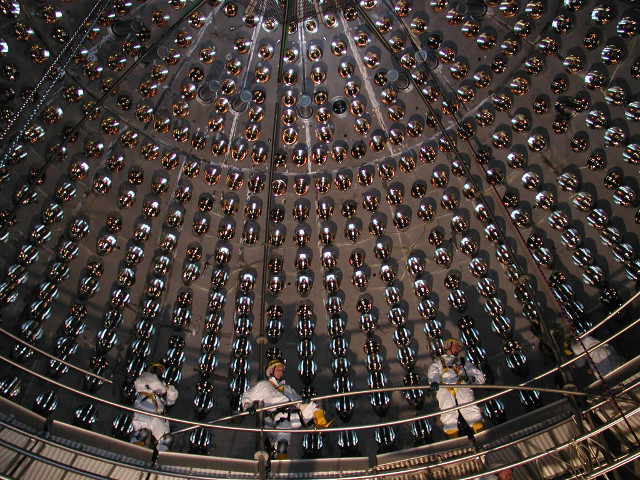
Men at work within the Borexino experiment (Photo courtesy Italian National Institute of Nuclear Physics. All rights reserved)

An article published in the journal “Nature” reports the detection of neutrinos produced by the Sun by the Borexino experiment. The scientists of the Borexino Collaboration at the Gran Sasso National Laboratories of the Italian National Institute of Nuclear Physics that conducted this investigation have thus obtained experimental evidence that the CNO (carbon-nitrogen-oxygen) cycle, which produces those neutrinos, powers the nuclear fusion that occurs in the solar core. This cycle is predominant in stars with a mass greater than the Sun, and this adds importance to the evidence offered to a theory developed more than 80 years ago.