
Astronomy / Astrophysics

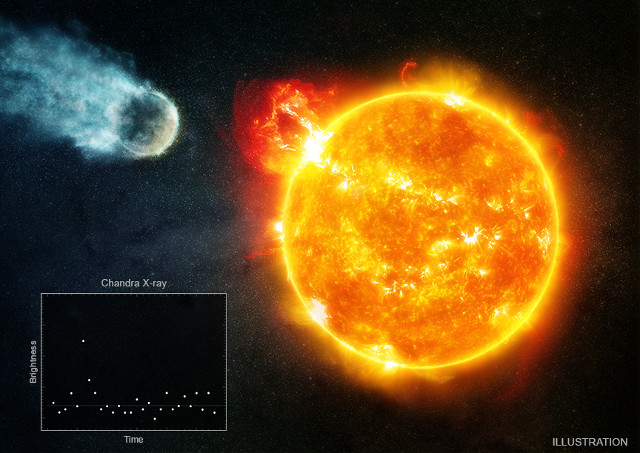
Artistic representation of Barnard's Star with a rocky planet hit by a flare with an X-ray component

An article published in “The Astronomical Journal” reports a study on the potential impact of the activity of a red dwarf several billion years old such as Barnard’s Star on the potential habitability of its planets. A team of researchers used data collected by NASA’s Chandra X-ray Observatory and the Hubble Space Telescope to keep an eye on Barnard’s Star and its flares observing one X-ray flare in June 2019 and two ultraviolet flares in March 2019. Basically, even if a red dwarf becomes quieter over time, its flares can still erode the atmosphere of a rocky planet.

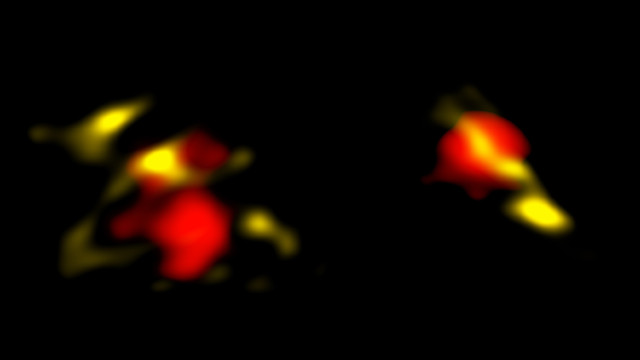
Two dusty galaxies detected by ALMA (Image B. Saxton NRAO/AUI/NSF, ALMA (ESO/NAOJ/NRAO), ALPINE team)

Eight articles published in the journal “Astronomy & Astrophysics” report as many studies connected to the ALPINE (ALMA Large Program to Investigate C+ at Early Times) project, conducted using the ALMA radio telescope in 70 hours of far infrared observations of 118 galaxies in the early universe. The researchers who conducted the various studies discovered among other things galaxies that are more mature than primordial, in the sense that they contain a significant amount of dust and metals, a situation found in galaxies where many stars were already produced and exploded into supernovae. This is a confirmation that the first cases of galaxies that were already mature when the universe was still young were not isolated.

The crater triplet in Noachis Terra (Image ESA/DLR/FU Berlin, CC BY-SA 3.0 IGO)

ESA has published photos taken by its Mars Express space probe’s High Resolution Stereo Camera (HRSC) of a crater triplet in the Noachis Terra region on planet Mars. That region gave its name to the Noachian era in which, between about 3.7 and 4.1 billion years ago, the red planet was hit by a particularly large number of meteorites, and Noachis Terra is full of craters still existing. A crater triplet with an overlap indicating three very close impacts is interesting not only as a curiosity but also for the geological history it can tell together with others from the same region.

The points of the various landings made by the lander Philae on the surface of comet 67P/Churyumov-Gerasimenko

An article published in the journal “Nature” reports a reconstruction of the trajectory of ESA’s Rosetta mission’s Philae lander in its touchdown on the surface of comet 67P/Churyumov-Gerasimenko. A team of researchers examined data collected by the Rosetta space probe and the Philae lander to find out where the latter made its second touchdown on the comet, which was followed by further bounces before finally landing. The study also showed that the affected materials contained an abundant amount of ice as soft as freshly laid snow, to the point of being described as softer than cappuccino froth.

The Moon, water, and the SOFIA flying telescope

Two articles published in the journal “Nature Astronomy” report as many studies on the presence of water on the Moon. A team of researchers used the SOFIA flying telescope to find direct evidence of the presence of water molecules even in regions other than the polar ones. Another team examined the so-called cold traps, regions in the shadows on the lunar surface where there’s perennial darkness that can allow the presence of water ice, mapping their distribution. In the end, the amount of water present on the Moon may be far greater than that known from previous research. However, there are still various questions, starting with the possibility that it’s partly present in glass beads and therefore not immediately usable in space missions.