Astronomy / Astrophysics

The area where hydroxylamine was detected

An article published in “The Astrophysical Journal Letters” reports the discovery of hydroxylamine, a precursor of RNA nucleotides, in the molecular cloud G+0.693-0.027, in the heart of the Milky Way. A team led by Víctor M. Rivilla, of the Centro de Astrobiología in Madrid and associated with the Italian National Institute of Astrophysics in Arcetri used the IRAM radio telescope to detect the chemical signature of hydroxylamine. Other molecules important in the formation of RNA and DNA were already detected in space, this is more evidence that at least part of life building blocks can somehow seed a newly formed planet bearing fruit where conditions are suitable.

The galaxy NGC 1365 seen by MUSE (Image ESO/TIMER survey)

ESO has published an image of the galaxy NGC 1365, also known as The Great Barred Spiral Galaxy, captured with the MUSE instrument mounted on the VLT in Chile. The nickname is due to its particular shape with two structures running from its center that extend to its borders. It’s an uncommon type of galaxy since about 15% of galaxies belong to it while spiral ones are common. In this case, there’s a second bar inside the main one. The observations conducted with MUSE will help to understand the dynamics of the stars within NGC 1365 and its supermassive black hole.

Comet C/2020 F3 NEOWISE seen from the Earth and its coma seen by Hubble (Image NASA, ESA, Q. Zhang (California Institute of Technology), A. Pagan (STScI), and Z. Levay)

The Hubble Space Telescope was used to observe comet NEOWISE, formally C/2020 F3, which notably shows the coma surrounding its nucleus. The images released were captured on August 8, and are the first photos taken by Hubble of such a bright comet at such a high resolution after it passed close to the Sun. On July 3, NEOWISE passed approximately 43 million kilometers from the Sun, the most critical moment because sometimes comets are torn to pieces. The new images show that this time the comet survived in its entirety and will return to the inner solar system only in 7,000 years.

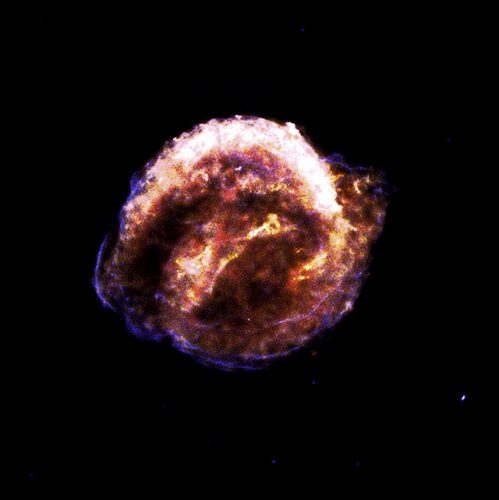
Kepler supernova remnants (Image NASA/CXC/Univ of Texas at Arlington/M. Millard et al.)

An article published in “The Astrophysical Journal” reports a study on the remnants of the so-called Kepler supernova, formally cataloged as SN 1604. A team of researchers led by Matthew Millard of the University of Texas at Arlington used data collected with NASA’s Chandra X-ray Observatory to observe materials moving away from the blast area. 15 “knots” of materials were observed in different periods thanks to their X-ray emissions, and one of them was found to have a speed higher than 37 million km/h, more than twice the average speed, while the shockwave is expanding at around 27 million km/h.

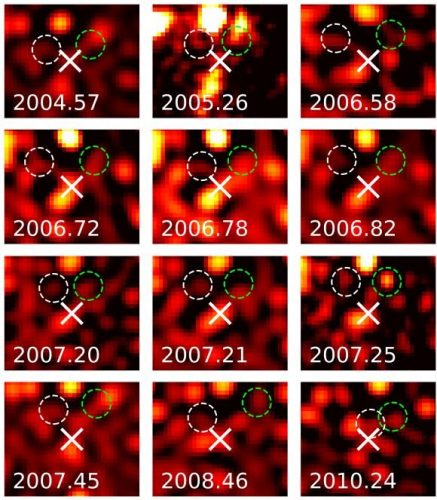
The star S4711 (Image courtesy Florian Peißker et al.)

Two articles published in “The Astrophysical Journal” report research on stars orbiting Sagittarius A*, or simply Sgr A*, the supermassive black hole at the center of the Milky Way, including the ones that reach the highest speed, S62 and S4714, and the one that goes through the orbit in the shortest time, S4711 in 7.6 Earth years. A team of researchers from the German University of Cologne led by Florian Peißker used observations made with the NACO and SINFONI instruments mounted on ESO’s VLT in Chile to track S62’s orbit. With the addition of two more researchers, the team also tracked the orbits of other stars in that area.