Astronomy / Astrophysics

The galaxy NGC 2090 as seen by the James Webb Space Telescope (ESA/Webb, NASA & CSA, A. Leroy)

ESA has published an image captured by the James Webb Space Telescope that portrays the galaxy NGC 2090 in the near and mid-infrared thanks to the combination of the MIRI (Mid-InfraRed Instrument) and NIRCam (Near-InfraRed Camera) instruments. This allowed to obtain an unprecedented amount of detail on this galaxy’s two spiral arms. For ESA, which participates in various astronomical missions, NGC 2090 is at the center of the scene these days because the choice for the Webb image of the month follows by a few days the choice for the Hubble Space Telescope image of the week, captured using various WFC3 (Wide Field Camera 3) instrument’s filters in the visible frequencies and an ultraviolet filter.

Artist's concept of the exoplanet TOI-3261 b being struck by stellar wind (Image NASA/JPL-Caltech/K. Miller (Caltech/IPAC))

An article published in “The Astronomical Journal” reports the identification of the exoplanet TOI-3261 b, an ultrahot Neptune very close to its star, one of the very few planets of that type known. A team of researchers used observations conducted with NASA’s TESS space telescope and detections obtained with the ESPRESSO and HARPS instruments to confirm its existence and obtain information on its characteristics. TOI-3261 b orbits in what is known as the Neptune desert precisely because it’s in an area where it’s very rare to find Neptune-type planets. For this reason, it will help to understand the evolution of certain types of planets.

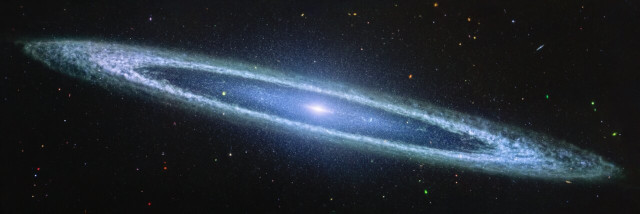
The Sombrero Galaxy as seen in infrared by the James Webb Space Telescope

A new image (NASA, ESA, CSA, STScI) captured by the James Webb Space Telescope depicts the Sombrero Galaxy in infrared. The MIRI (Mid-Infrared Instrument) instrument offers details invisible to other telescopes, creating a portrait different from what astronomers are used to. The nucleus is very bright at visible light frequencies while in infrared a smooth inner disk is revealed. The outer disk is “clumpy” and this allows to understand the distribution of dust inside it, an important result to get an idea of ​​the ongoing star formation processes.

The WOH G64 star seen from the VLTI (ESO Image/K. Ohnaka et al.)

An article published in the journal “Astronomy & Astrophysics” reports the creation of a detailed image of the red supergiant star WOH G64 and its surroundings, the first ever obtained of a star outside the Milky Way. A team of researchers led by astrophysicist Keiichi Ohnaka of the Universidad Andrés Bello, Chile, used the GRAVITY instrument on ESO’s VLTI in Chile to obtain details of this star in the Large Magellanic Cloud. This study may provide important insights into a star that is going through the death throes that will end with its explosion as a supernova. A dust cocoon and a possible torus surrounding WOH G64 show signs of that death throes.

The ultramassive galaxies S1, S2, and S3

An article published in the journal “Nature” reports the discovery of three ultramassive galaxies in the early universe in which stars are forming with an efficiency almost twice that of galaxies of average mass by the standards of that era. A team of researchers coordinated by the University of Geneva (UNIGE) used observations conducted with the James Webb space telescope within the FRESCO program. The three galaxies (Image NASA/CSA/ESA, M. Xiao & P. ​​A. Oesch (University of Geneva), G. Brammer (Niels Bohr Institute), Dawn JWST Archive), which were cataloged as S1, S2, and S3, are almost as massive as the Milky Way and add to others that were discovered in recent years and are difficult to explain with the most accepted cosmological models, starting with lambda-CDM.