Astronomy / Astrophysics

Protostars in the Orion Complex

Two articles published in “The Astrophysical Journal” report the study of a total of over 300 protostars with their protoplanetary disks in the Orion Complex, a group of molecular clouds that are perfect nurseries for the birth of new stars. A team of researchers led by John Tobin of the National Radio Astronomy Observatory (NRAO) used the data collected by the VLA and ALMA radio telescopes during the VLA/ALMA Nascent Disk and Multiplicity (VANDAM) survey to identify the four youngest protostars in the Orion Complex. A team expanded with the addition of other researchers investigated 328 protostars identified in those molecular clouds.

Artist's concept of hot Jupiter close to its star (Image courtesy University of Warwick/Mark Garlick)

An article published in the journal “Monthly Notices of the Royal Astronomical Society” reports a study on the exoplanet NGTS-10b, an ultra-hot Jupiter whose year lasts only about 18 hours. A team of researchers led by Dr James McCormac of the British University of Warwick used data collected during the NGTS survey to identify NGTS-10b thanks to its transits in front of its star. It’s the hot or ultra-hot Jupiter closest to its star observed so far, so close to it that in the distant future it could approach the point of being destroyed. This makes it an interesting object of study, also because observations conducted for several years will measure its orbit’s changes to understand if it’s really doomed.

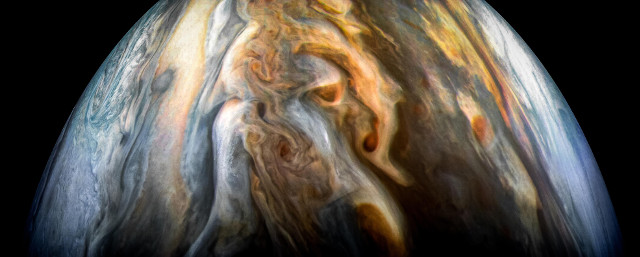
Jupiter's equatorial region

An article published in the journal “Nature Astronomy” reports a study on the abundance of water in the atmosphere and in particular in the equatorial region of the planet Jupiter. NASA’s Juno mission team used data collected by the space probe, which has been orbiting the gas giant for about 3.5 years. The conclusion is that water makes up about 0.25% of the molecules in Jupiter’s atmosphere, about three times those present in the Sun’s atmosphere estimated through the presence of its components. This is a result that indicates an abundance much higher than that measured in 1995 by the Galileo space probe.

Titan (NASA/JPL-Caltech/Space Science Institute)

An article published in “The Astrophysical Journal” reports a study of the chemical compounds in the atmosphere of Titan, Saturn’s great moon. Takahiro Iino of the University of Tokyo, together with Hideo Sagawa of Kyoto Sangyo University and Takashi Tsukagoshi of NRAO (National Astronomical Observatory of Japan) used the ALMA radio telescope to detect the chemical signatures of the compounds existing on Titan discovering that of acetonitrile, including a rare isotopomer that contains nitrogen-15.

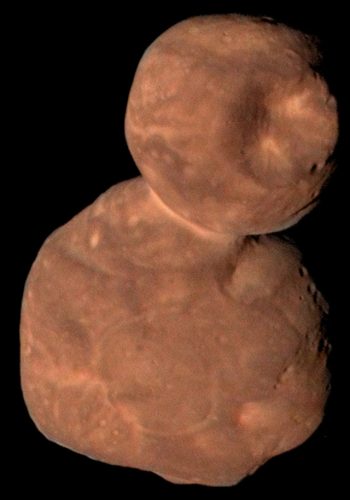
Arrokoth (Image NASA/Johns Hopkins University Applied Physics Laboratory/Southwest Research Institute/Roman Tkachenko)

Three articles published in the journal “Science” report various aspects of a research on the origins and characteristics of Arrokoth, the Kuiper Belt object classified as 2014 MU69 and for some time known by the nickname Ultima Thule. Different teams of researchers with various members in common used data collected by NASA’s New Horizons space probe to study it from various points of view. One of the conclusions concerns its origin, which might have occurred following the collapse of a cloud of solid particles in the primordial solar nebula and not following the process known as hierarchical accretion, a process that has high-speed collisions between planetesimals.