Astronomy / Astrophysics

The center of the Centaurus galaxy A and the source C4 (Image NASA/CXC/SAO/D. Bogensberger et al.; Image Processing: NASA/CXC/SAO/N. Wolk)

An article published in the journal “The Astrophysical Journal” reports the results of X-ray observations of the jets emitted by the supermassive black hole at the center of the Centaurus A galaxy. A team of researchers used NASA’s Chandra X-ray Observatory to find a V-shaped structure that indicates that one of the jets hit something whose nature is uncertain. Only Chandra’s X-ray observations revealed that unusual structure, cataloged as C4, while many other instruments, especially radio telescopes, had never shown such anomalies.

A group of galaxies observed by the James Webb Space Telescope (Image NASA, ESA, CSA)

An article published in “The Astrophysical Journal” reports the results of a new measurement of the universe’s expansion rate obtained using observations conducted with the James Webb Space Telescope that confirms previous results obtained with Hubble. A team of researchers led by Adam Riess, who has been investigating the expansion of the universe for years, verified that the so-called Hubble tension, as the discrepancy between different measurements is called, was not due to limitations of the Hubble Space Telescope. According to Riess, this result confirms that our cosmological models are incomplete and there may be something we don’t yet understand about the universe.

The galaxy NGC 2090 as seen by the James Webb Space Telescope (ESA/Webb, NASA & CSA, A. Leroy)

ESA has published an image captured by the James Webb Space Telescope that portrays the galaxy NGC 2090 in the near and mid-infrared thanks to the combination of the MIRI (Mid-InfraRed Instrument) and NIRCam (Near-InfraRed Camera) instruments. This allowed to obtain an unprecedented amount of detail on this galaxy’s two spiral arms. For ESA, which participates in various astronomical missions, NGC 2090 is at the center of the scene these days because the choice for the Webb image of the month follows by a few days the choice for the Hubble Space Telescope image of the week, captured using various WFC3 (Wide Field Camera 3) instrument’s filters in the visible frequencies and an ultraviolet filter.

Artist's concept of the exoplanet TOI-3261 b being struck by stellar wind (Image NASA/JPL-Caltech/K. Miller (Caltech/IPAC))

An article published in “The Astronomical Journal” reports the identification of the exoplanet TOI-3261 b, an ultrahot Neptune very close to its star, one of the very few planets of that type known. A team of researchers used observations conducted with NASA’s TESS space telescope and detections obtained with the ESPRESSO and HARPS instruments to confirm its existence and obtain information on its characteristics. TOI-3261 b orbits in what is known as the Neptune desert precisely because it’s in an area where it’s very rare to find Neptune-type planets. For this reason, it will help to understand the evolution of certain types of planets.

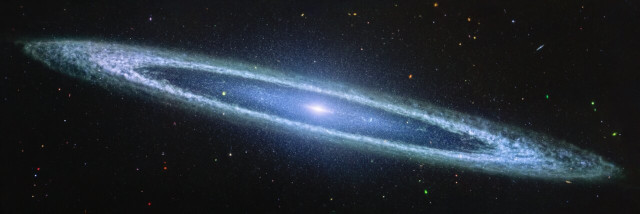
The Sombrero Galaxy as seen in infrared by the James Webb Space Telescope

A new image (NASA, ESA, CSA, STScI) captured by the James Webb Space Telescope depicts the Sombrero Galaxy in infrared. The MIRI (Mid-Infrared Instrument) instrument offers details invisible to other telescopes, creating a portrait different from what astronomers are used to. The nucleus is very bright at visible light frequencies while in infrared a smooth inner disk is revealed. The outer disk is “clumpy” and this allows to understand the distribution of dust inside it, an important result to get an idea of ​​the ongoing star formation processes.