Astronomy / Astrophysics

The "cotton candy exoplanets" of the Kepler 51 system studied with the Hubble Space Telescope

An article to be published in “The Astronomical Journal” reports a study on three gas exoplanets discovered in the Kepler 51 system belonging to a rare type that has a very low density even by the standards of these planets. A team of researchers led by Jessica Libby-Roberts, a graduate student at the University of Colorado, Boulder, used the Hubble Space Telescope to study those three exoplanets confirming their density so low as to deserve nicknames such as “cotton candy planets” or “super puffs”. This study suggests that they’re quickly losing mass so in the distant future they could turn into mini-Neptunes, a much more common category.

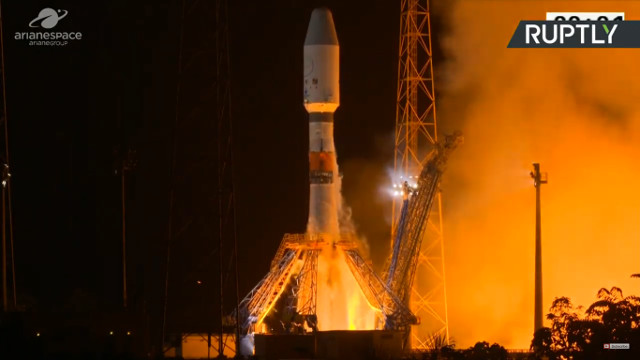
CHEOPS and Cosmo-SkyMed Second Generation blasting off atop aSoyuz rocket (Image courtesy Arianespace)

A few hours ago a Soyuz rocket was launched from the Kourou base, in French Guiana. After about 23 minutes the Cosmo-SkyMed Second Generation satellite successfully separated from the rocket’s Fregat last stage. About 85 minutes after the launch, the CHEOPS space telescope successfully separated from the rocket’s Fregat last stage.

The COSMO-SkyMed Second Generation satellite is the first of a constellation of two satellites that aims to replace the first generation’s four satellites. It’s a system of radar satellites for the territory observation, the result of a collaboration between the Italian Space Agency and the Italian Ministry of Defense.

The purpose of ESA’s CHEOPS (Characterizing ExOPlanets Satellite) space telescope is to conduct follow-up study of exoplanets using the transit method, which means observing the ones that pass in front of their star.

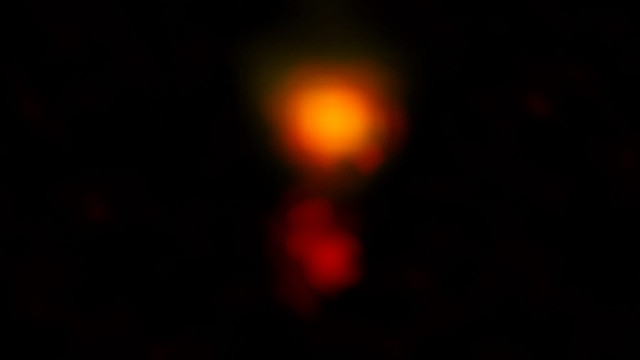
MAMBO-9 is a dusty galaxy 13 billion light years away

An article published in “The Astrophysical Journal” reports a study on a dusty early galaxy known as MAMBO-9. A team of researchers led by Caitlin Casey of the University of Texas at Austin used the ALMA radio telescope to study this galaxy about 13 billion light years away and its star formation rate much higher than the Milky Way’s. The observations showed that actually they’re two galaxies during a merger. That’s all useful to understand the role of dusty galaxies like that one in the evolution of the universe.

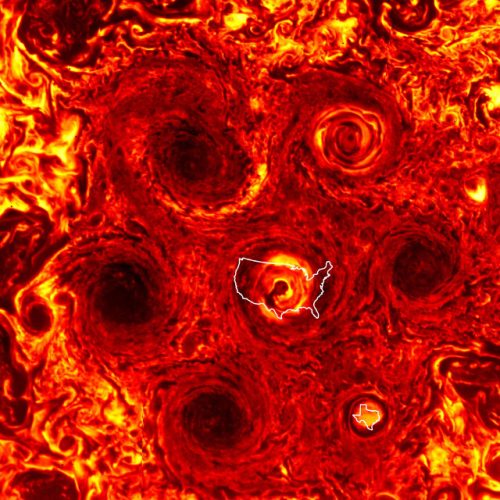
Jupiter's south pole seen by JIRAM

A new cyclone was discovered at the south pole of the planet Jupiter by NASA’s Juno space probe. In particular, it was the JIRAM instrument that captured the first images in which you can see that the configuration of the cyclones existing in that area changed from a pentagon of cyclones surrounding a central one to a hexagon, still around a central one. The new cyclone seems small compared to the ones already existing but its surface is comparable to that of Texas. This discovery was made during a Jupiter flyby that follows a maneuver needed to prevent Juno from ending up in the planet’s shadow for 12 hours. Without being powered by solar panels, its batteries would have completely drained and its temperature would have dropped to lethal levels.

A fragment of Muonionalusta meteorite

An article published in the journal “Nature Astronomy” reports an analysis of the isotopic composition of six groups of iron meteorites, and the results offer evidence that some of the materials that formed the planet Earth came from red giant stars. Mattias Ek of the University of Bristol, Alison C. Hunt, Maria Lugaro and Maria Schönbächler examined in particular the isotopic composition of palladium finding that some dust has a composition that can be produced only by nuclear reactions that take place in red giants’ inner regions. This offers an explanation of the greater presence of that type of dust on Earth than on Mars or in asteroids.