Astronomy / Astrophysics

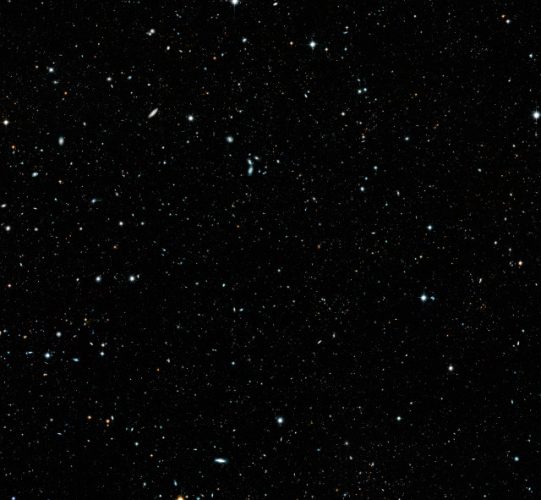
Thousands of images from the Hubble Space Telescope provide a wide view of the universe and its history

A mosaic of images created by combining 7,500 images captured by the Hubble Space Telescope offers a portrait of a part of the universe containing 265,000 galaxies up to 13.3 billion light years away, which means that we see the most distant of them as they were about 500 million years after the Big Bang. The result was named the Hubble Legacy Field and also combines observations taken from various deep field campaigns of the past years at wavelengths ranging from ultraviolets to near infrareds. It also shows the universe that evolves over time.

The black hole V404 Cygni swings like a spinning top

An article published in the journal “Nature” reports the observation of a jet of materials emitted by the black hole V404 Cygni which changed orientation in no more than a few hours. A team led by James Miller-Jones of the Curtin University node of the International Center for Radio Astronomy Research (ICRAR), Australia, used the Very Long Baseline Array radio telescopes to study the area around the black hole during one of its periodic bursts of considerable intensity. This made it possible to observe for the first time jets of materials changing orientation in a few hours or even minutes.

The position of quasars varies over time

An article published in the journal “Monthly Notices of the Royal Astronomical Society” reports evidence that the position of quasars is not fixed. A team of astrophysicists from the Moscow Institute of Physics and Technology combined global observations of 40 quasars between 1994 and 2016 for this study. Based on the fact that the apparent positions of quasars change according to the frequency of the radiation used to observe them, the researchers wanted to verify if that effect could vary over time. Quasars are used as cosmic reference points, knowing their exact location can increase their reliability.

The extent of the expansion of the universe is increasingly precise and stresses the discrepancy between the measurements

An article published in “The Astrophysical Journal” reports a new measurement of the expansion of the universe, which is approximately 9% faster than the estimates made by studying the early universe. A team of astronomers led by Nobel laureate Adam Riess combined observations made with the Hubble Space Telescope of 70 variable stars called Cepheid variables used for measurements with others conducted by the Araucaria project to obtain extremely precise measurements of their brightness. The discrepancy between the measurements of the expansion of the near universe and those of the early universe remains and it’s important to improve the measurements to obtain clues to the origin of the discrepancy.

A measurement of the temperatures on the surface of comet 67P/Churyumov-Gerasimenko

An article published in the journal “Nature Astronomy” reports a series of measurements of the temperature of comet 67P/Churyumov-Gerasimenko’s nucleus obtained thanks to ESA’s Rosetta space probe’s VIRTIS instrument. A team of researchers led by Federico Tosi of the National Institute of Astrophysics’ Space Astrophysics and Planetology Institute in Rome, Italy, used the infrared images captured by VIRTIS to generate thermal maps from which they obtained the temperatures reconstructing the daily and seasonal variations but also the ones related to its morphological characteristics and the chemical-physical characteristics of the top surface layer.