Astronomy / Astrophysics

Coma Cluster (Image CTIO/NOIRLab/DOE/NSF/AURA. Image Processing: D. de Martin & M. Zamani (NSF NOIRLab)

An image captured by the Dark Energy Camera (DECam) depicts the Coma Cluster, also known as Abell 1656, so named because it’s part of the constellation Coma Berenices. DECam was designed to conduct a long-term investigation of dark energy but is also useful for other types of astronomical studies. The Coma Cluster is linked to the study of dark matter since the inconsistency between the estimate of its overall mass and the measurement of its gravitational effects stimulated the research that led to today’s dark matter models.

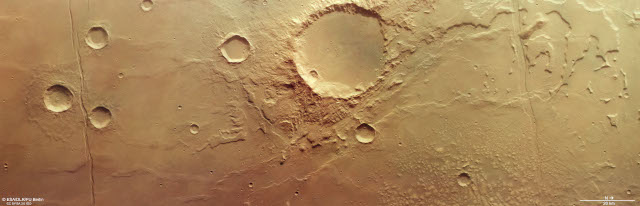
The Caralis Chaos on Mars

An image captured by ESA’s Mars Express space probe’s High Resolution Stereo Camera (HRSC) shows the region of the planet Mars called Caralis Chaos. At first glance, it may seem like just another Martian area dotted with craters and wind-carved mounds, but when the red planet was young, it was home to Lake Eridania, larger than all the lakes on Earth. It covered an area of ​​more than a million square kilometers, including Atlantis Chaos, an area close to Caralis Chaos. That lake gradually dried up as the environmental collapse transformed an Earth-like planet into the one we see today.

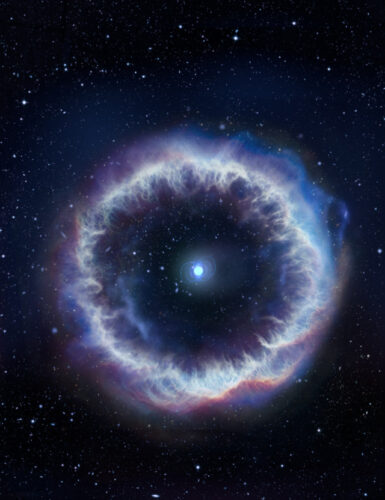
Artist's illustration of a magnetar surrounded by a plasma bubble (Image S. Dagnello, NSF/AUI/NRAO)

An article published in the journal “Nature” reports the results of a study on some fast radio bursts linked to persistent emissions that associates that long duration with a bubble of plasma that generates that radiation. A team of researchers led by the Italian National Institute for Astrophysics registered and studied the fast radio burst with the weakest persistent emission detected so far, cataloged as FRB20201124A, and two other similar events with the VLA radio telescope collecting data that provide evidence of the presence of the plasma bubble at the origin of the radio emissions.

An image of the asteroid Dimorphos (a) with a magnified area (b) that was analyzed in one of the articles and a mapping of the fractures of the boulders (c)

Five articles published in the journal “Nature Communications” report different analyses of data collected by NASA’s DART spacecraft and the Italian Space Agency’s LICIACube nanosatellite that accompanied it on its mission that ended with the collision with Dimorphos, a small satellite asteroid of Didymos, which occurred on September 26, 2022. Various teams of researchers with members in common offered possible reconstructions of the processes that led to the formation of the pair of asteroids and their characteristics. These studies are connected to the defense of the Earth from asteroid impacts.

The three primordial galaxies (Image courtesy JWST/NIRSpec, Bingjie Wang/Penn State)

An article published in “The Astrophysical Journal Letters” reports the results of the study of three very compact primordial galaxies with characteristics that can’t be explained by current cosmological models. A team led by researchers from Penn State University used observations conducted with the James Webb Space Telescope within the RUBIES survey to examine three objects that were considered mysterious for their strange characteristics.

In an article published in the journal “Nature” the researchers had already proposed that those were galaxies, and the new examination of the data confirms that. We see them as they were when the universe was between 600 and 800 million years old but their emissions indicate that they contain stars that are already relatively old and supermassive black holes with masses that were already enormous, perhaps more than the one at the center of the Milky Way.