Astronomy / Astrophysics

A verification of dark matter heating

An article published in the journal “Monthly Notices of the Royal Astronomical Society” reports confirmations to the hypothesis of the effect known as dark matter heating. A team of researchers looked for the effects of the presence of dark matter in dwarf galaxies relatively close to the Milky Way, finding the confirmation that star formation can heat it causing it to move outwards. It’s a new possibility to study dark matter to try to understand its nature.

Ultima Thule offers the first answers but leaves many questions open

In a press briefing that included a number of scientists working on NASA’s New Horizons mission, the first discoveries on the Kuiper Belt object cataloged as 2014 MU69 and nicknamed Ultima Thule were presented, obtained thanks to data received during the January 1, 2019 flyby. They’re based on information that’s still incomplete, which could be contradicted by high resolution photos and other data but for the moment this object doesn’t appear to have neither moons nor rings, or at least not of relevant sizes, no impact craters were found on its surface nor were traces of atmosphere.

Ultima Thule is made up of two smaller asteroids

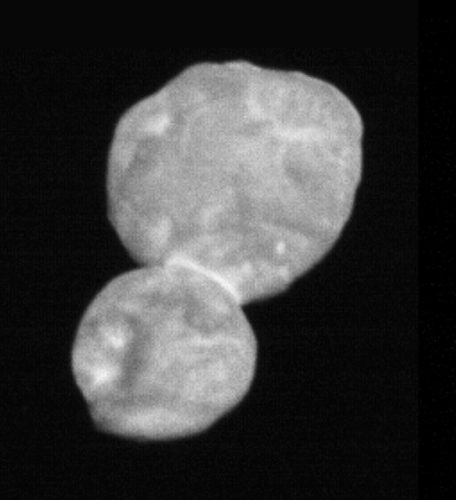
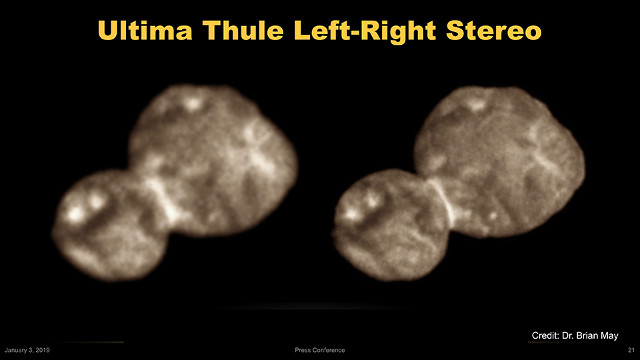
NASA published the first detailed images of the Kuiper Belt object cataloged as 2014 MU69 and nicknamed Ultima Thule. Captured by the New Horizons space probe’s LORRI and MVIC instruments approximately 90 to 30 minutes before its closest approach, they finally clearly show this object’s double-lobe structure. In jargon, it’s called a contact binary and is the result of two close objects that collide at low speed and end up merging. The larger lobe has been nicknamed Ultima and the smaller Thule.

The New Horizons space probe performed its Ultima Thule flyby

NASA’s New Horizons spacecraft has just completed its flyby of the object known as 2014 MU69 and nicknamed Ultima Thule. The automatic program to proceed with the photos and the other detections of its target was activated a few days ago so, after sending the last images taken when it was still almost two million kilometers away, New Horizons aimed its instruments at Ultima Thule. If all went well, in the next few hours it will communicate it to the mission control center and start sending the data it collected, a process that will continue for an estimated time in about 20 months.