Astronomy / Astrophysics

The star HD 186302 at the center (Image courtesy CDS Portal/Simbad)

An article published in the journal “Astronomy & Astrophysics” describes the discovery of a twin star of the Sun. It’s HD 186302, studied by a team of researchers led by Vardan Adibekyan of the Instituto de Astrofísica and Ciências do Espaço (IA), in Portugal, starting from the data collected by the AMBRE project that collected about 230,000 star spectra, along with other data collected by ESA’s Gaia space probe. HD 186302 is really similar to the Sun not only as an age and chemical composition but also in mass and size and this offers hopes that it has planets similar to the Earth.

The brightest known galaxy is devouring its neighbors

An article published in the journal “Science” describes a study of the galaxy W2246-0526, the brightest known. A team of researchers used the ALMA radio telescope to examine it by uncovering streams of materials as they are stripped from three smaller galaxies orbiting it. In one case a “tidal tail” is generated, a large stram of materials that connects W2246-0526 with one of its satellites. According to an article published in “The Astrophysical Journal” the supermassive black hole at its center has a mass that’s about 4 billion times the Sun’s.

Artist's concept of Barnard's Star and its planet Barnard’s Star b (Image ESO/M. Kornmesser)

An article (link to PDF file) published in the journal “Nature” describes the discovery of a possible super-Earth orbiting the Barnard’s Star, a red dwarf that in astronomical terms is in the neighborhood being about 6 light years away from the Earth. The Red Dots and CARMENES projects led to the discovery of what was named Barnard’s Star b and could be the second exoplanet closest to the solar system after Proxima b.

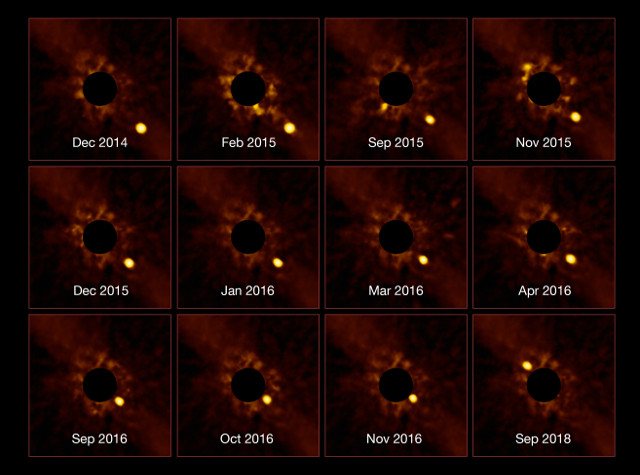
Beta Pictoris b (Image ESO/Lagrange/SPHERE consortium)

ESO has published a time-laps composition of images showing the exoplanet Beta Pictoris b while orbiting its star. It was discovered in 2008 using the NACO instrument mounted on the VLT in Chile and the team led by Dr. Anne-Marie Lagrange who discovered it kept on studying it some years later using the SPHERE instrument, which in the meantime was also mounted on the VLT. The researchers lost sight of it when it approached its star’s halo too closely to be resolved by any current instrument but got visible again in September 2018.

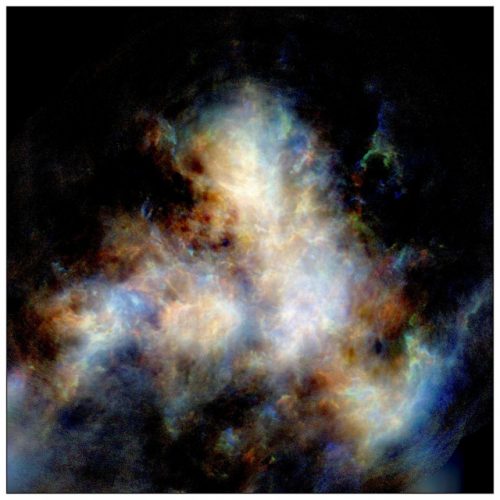
Hydrogen in the Small Magellanic Cloud (Image courtesy Naomi McClure-Griffiths et al, CSIRO's ASKAP telescope. All rights reserved)

An article published in the journal “Nature Astronomy” describes the study of a gas outflow from the Small Magellanic Cloud that extends for at least 6,500 light years from its star formation area. A team of researchers used the ASKAP radio telescope to observe that dwarf galaxy in its entirety in a single shot with details never seen before. The conclusion is that there’s a gas loss resulting in a drop in star formation. That gas could be a source for what is known as Magellanic Stream and over time the Small Magellanic Cloud could be devoured by the Milky Way.