
Astronomy / Astrophysics

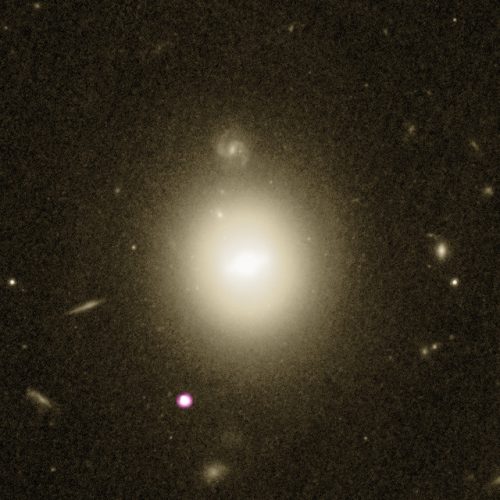
The galaxy galaxy 6dFGS gJ215022.2-055059 and the intermediate-mass black hole candidate

An article published in the journal “Nature Astronomy” describes the discovery of the best candidate found so far for a type of black hole that’s been elusive for a long time. A team led by Dacheng Lin of the University of New Hampshire’s Space Science Center used observations from a number of telescopes to detect flares at various wavelengths emitted in the area near an intermediate-mass black hole while destroying a nearby star in what is called the tidal disruption event.

The Medusae Fossae Formation seen by Mars Odyssey. Mars based on data from the MOLA instrument (Image NASA, modified by Chmee2)

An article published in the journal “Journal of Geophysical Research: Planets” describes a research on the Medusae Fossae Formation on Mars. A team of researchers coordinated by the Johns Hopkins University analyzed this geological formation finding its possible origin in explosive volcanic eruptions that over three billion years ago ejected ash, rock and gas. It could add important information about Mars interior and its past.

The galaxies Arp 299A and Arp 299B and the tidal disruption event

An article published in the journal “Science” describes the discovery of a star destroyed by a supermassive black hole in what in jargon is called a tidal disruption event. A team of astronomers used various telescopes searching for supernovae in Arp 299, an object generated by two merging galaxies, but in one case they came to realize that the phenomenon in progress was not an explosion but the destruction of the star under observation.

A representation of the data collected with OSIRIS

During the 232nd American Astronomical Society Meeting, a team of researchers led by Anna Ciurlo of UCLA presented the results of a research on what were called G-objects. They look like dust clouds but act like stars and move very fast in the area around the supermassive black hole at the center of the Milky Way. Using data collected over the past 12 years by the Keck Observatory in Hawaii, the researchers concluded that these are bloated stars, so large that the black hole steal their materials from them.

Artist's concept of nanodiamonds in a protoplanetary disk (Image courtesy S. Dagnello, NRAO/AUI/NSF)

An article published in the journal “Nature Astronomy” describes the detection of nanodiamonds around three newborn star systems in the Milky Way. A team of researchers led by astronomer Jane Greaves of the Welsh University of Cardiff used the Green Bank Telescope (GBT) to observe the V892 Tau system and the Australia Telescope Compact Array (ATCA) to observe the HD 97048 and MWC 297 systems obtaining the first clear detections of anomalous microwave emissions (AMEs) concluding that the nanodiamonds are their source.