Astronomy / Astrophysics

An image of the asteroid Dimorphos (a) with a magnified area (b) that was analyzed in one of the articles and a mapping of the fractures of the boulders (c)

Five articles published in the journal “Nature Communications” report different analyses of data collected by NASA’s DART spacecraft and the Italian Space Agency’s LICIACube nanosatellite that accompanied it on its mission that ended with the collision with Dimorphos, a small satellite asteroid of Didymos, which occurred on September 26, 2022. Various teams of researchers with members in common offered possible reconstructions of the processes that led to the formation of the pair of asteroids and their characteristics. These studies are connected to the defense of the Earth from asteroid impacts.

The three primordial galaxies (Image courtesy JWST/NIRSpec, Bingjie Wang/Penn State)

An article published in “The Astrophysical Journal Letters” reports the results of the study of three very compact primordial galaxies with characteristics that can’t be explained by current cosmological models. A team led by researchers from Penn State University used observations conducted with the James Webb Space Telescope within the RUBIES survey to examine three objects that were considered mysterious for their strange characteristics.

In an article published in the journal “Nature” the researchers had already proposed that those were galaxies, and the new examination of the data confirms that. We see them as they were when the universe was between 600 and 800 million years old but their emissions indicate that they contain stars that are already relatively old and supermassive black holes with masses that were already enormous, perhaps more than the one at the center of the Milky Way.

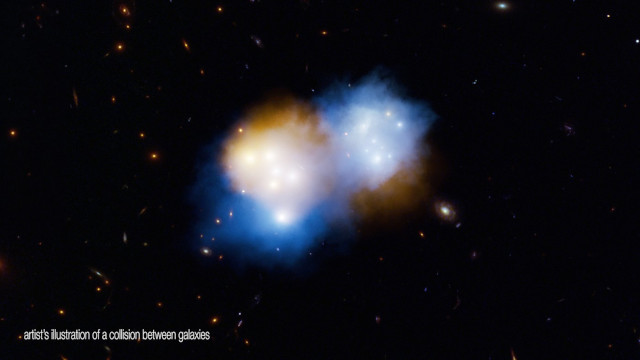
Artist's concept of MACS J0018.5 with dark matter in blue and baryonic matter in orange (Image courtesy W.M. Keck Observatory/Adam Makarenko)

An article published in the journal “The Astrophysical Journal” reports the results of a study on the ongoing merger between two galaxy clusters that are forming a single new cluster cataloged as MACS J0018.5+1626, or simply MACS J0018.5. A team of researchers used data obtained from observations dating back even decades conducted with various space and ground-based telescopes, analyzing them to decouple the behavior of ordinary matter and dark matter.

To measure the speed of intergalactic gas composed of normal matter, they used the kinematic Sunyaev-Zel’dovich (SZ) effect. The speed of dark matter is roughly the same as galaxies. The result is that dark matter moves faster than normal matter. This result offers clues about dark matter and its behavior that are useful in studies of its nature.

Artist’s Impression of a Hot Jupiter Progenitor with its star in the background (Image NOIRLab/NSF/AURA/J. da Silva (Spaceengine))

An article published in the journal “Nature” reports a study on the exoplanet cataloged as TIC 241249530 b which labels it as a progenitor of a hot Jupiter. A team of researchers used various telescopes to study TIC 241249530 b and try to understand its characteristics and evolution. This gas giant has an extremely eccentric orbit, meaning it’s extremely elongated, which could change greatly as time passes.

Observations and simulations suggest that the star’s gravitational action will drive this planet to have an almost circular orbit close to the star itself. This led the researchers to conclude that TIC 241249530 b is in the first phase of a planetary migration. The star is slightly more massive than the Sun and has an age estimated at just over three billion years, which indicates that these processes can begin well after the formation of a planetary system.

The Einstein ring cataloged as PJ0116-24 (Image ALMA (ESO/NAOJ/NRAO)/ESO/D. Liu et al.)

An article published in the journal “Nature Astronomy” reports the results of a study of the Hyper Luminous Infrared Galaxy (HyLIRG) cataloged as PJ0116-24 which offers some surprises about this type of galaxy. A team of researchers combined observations conducted with the ALMA radio telescope and the Enhanced Resolution Imager and Spectrograph (ERIS) instrument mounted on ESO’s VLT to obtain details of PJ0116-24.

The complication in the study comes from the fact that it’s about 10 billion light-years away from Earth and is visible thanks to a gravitational lensing effect that makes it appear like a so-called Einstein ring, a name due to the fact that it’s a result predicted by the theory of general relativity. The surprise is due to the fact that the researchers expected to find traces of a galaxy merger while the details indicate that it’s an orderly galaxy although very active in star formation.