Astronomy / Astrophysics

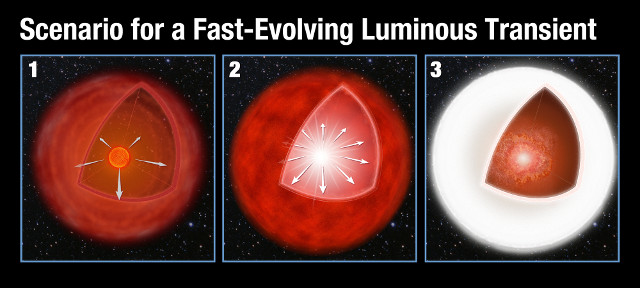
Scenario of a FELT event (Image NASA, ESA, and A. Feild (STScI) )

An article published in the journal “Nature Astronomy” describes a research that offers an explanation to a type of extremely bright event called Fast-Evolving Luminous Transient (FELT), that lasts just a few days. A team of researchers took advantage of the ability of NASA’s Kepler space telescope to accurately detect rapid changes in starlight to build a model in which a FELT event is caused by a large shell of gas and dust around a supernova, which makes it shine.

A measure of the Leading Arm

An article published in the journal “The Astrophysical Journal” describes a research on the Leading Arm of the Magellanic Stream, a huge field of gas clouds that connect the Milky Way to the two Magellanic Clouds, two dwarf galaxies satellite of ours. A team of researchers used the Hubble Space Telescope to study a kind of cosmic tug-of-war between the Large and the Small Magellanic Cloud that generated the cloud that the Milky Way is slowly absorbing.

Artist's concept of the panorama on the planet TRAPPIST-1f (Image NASA/JPL-Caltech/T. Pyle (IPAC))

An article published in the journal “Nature Astronomy” describes a research into the possible migration of the orbits of the 7 planets of the ultra-cool dwarf star TRAPPIST-1’s system and their composition. A team of researchers from Arizona State University (ASU) and Vanderbilt University put together the information available on that system to perform a series of calculations concluding that the planets formed much farther away from their star from their current positions and that some of them have a very high water content, paradoxically too much for them to be habitable.

The possible ancient oceans of Mars (Image courtesy Robert Citron images, UC Berkeley. All rights reserved)

An article published in the journal “Nature” describes a research on the oceans that formed on Mars when the planet was young. A team of geophysicists from the University of California at Berkeley provided what are believed to be evidence of a connection between those oceans’ formation and the volcanic system of the Tharsis region, the largest of the solar system, which might have warmed the surface enough to keep water liquid for a long time.

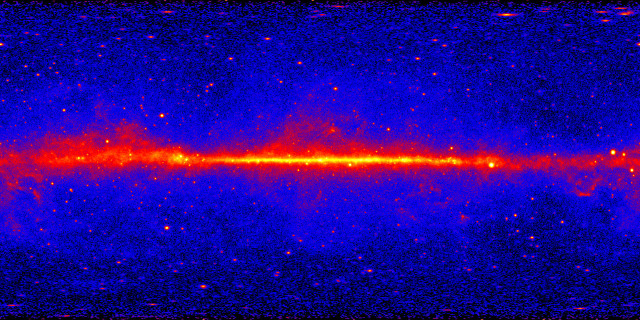
Map of high-energy Gamma Rays (Image NASA/DOE/Fermi LAT Collaboration)

An article published in the journal “Nature Astronomy” describes a research that indicates the origin in an anomalous gamma-ray source detected for the first time in 2009 by the NASA’s Fermi gamma-ray space telescope. One of the hypotheses concerned collisions of dark matter particles, instead according to a team of astronomers there are millisecond pulsars in the nucleus of the Milky Way whose emissions mixed up in the signal detected by Fermi.