Astronomy / Astrophysics

M77's active galactic nucleus with the gas moving in the inset (Image ALMA (ESO/NAOJ/NRAO), Imanishi et al.)

An article published in the journal “Astrophysical Journal Letter” describes the best observation ever made of a ring of gas and dust surrounding a supermassive black hole. A team of astronomers used the ALMA radio telescope to observe the active galactic nucleus (AGN) of the M77 spiral galaxy that emits the intense electromagnetic radiation detected. This is the definitive proof of what was initially proposed as a theoretical concept for which increasingly clearer evidence was collected over time up to that presented in this research.

Hyperbolic trajectory of ʻOumuamua

An article published in the journal “Nature Astronomy” describes a research on the tumbling of the interstellar asteroid 1I/2017 U1, commonly known as ‘Oumuamua. According to a team of astronomers led by Queen’s University Belfast, that motion is due to an impact with another object that occurred before it was ejected from its solar system and could continue for at least another billion years.

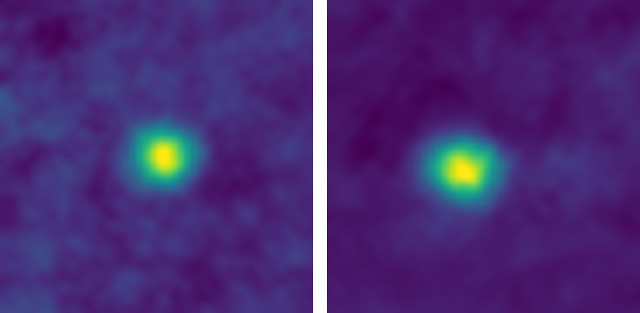
False-color photo of 2012 HZ84 and 2012 HE85 (Image NASA/JHUAPL/SwRI)

NASA has published some photos taken by its New Horizons space probe’s LORRI instrument in December 2017. During the course of its journey that will lead to the object called 2014 MU69’s flyby, New Horizons took photos that beat the record that belonged to Voyager 1 for the farthest photo ever taken from Earth capturing images of the open stellar cluster called Wishing Well and two Kuiper Belt Objects called 2012 HZ84 and 2012 HE85.

Artist's concept of TRAPPIST-1's planets with the Earth (Image ESO/M. Kornmesser)

Two articles, one published in the journal “Astronomy & Astrophysics” and one in the journal “Nature Astronomy”, describe two researches on the TRAPPIST-1 system’s rocky planets. Various telescopes, both space and ground-based, allowed to gather more information on those 7 exoplanets and to improve the measurements of their characteristics. An important result is the estimate of their density, which suggests that some of them are composed up to 5% of water. Spectroscopic detections suggest that at least 3 of them have a compact atmosphere that could allow liquid water to exist on their surface.

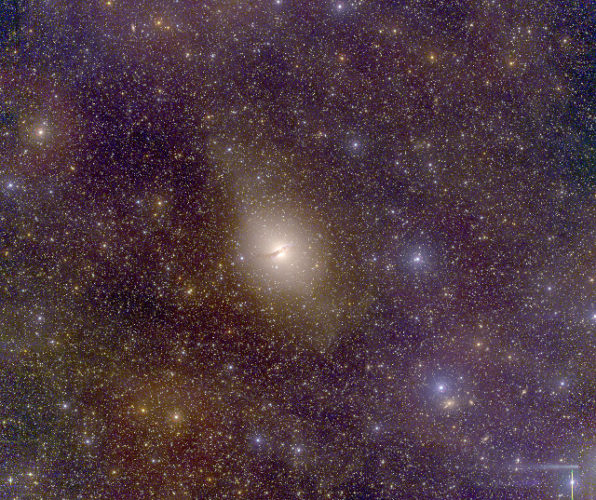
Centaurus A and its dwarf satellite galaxies (Image Christian Wolf and the SkyMapper team / Australian National University)

An article published in the journal “Science” describes a research that shows what appears to be a discrepancy between the observations of a group of galaxies and the current models about dark matter. A team of astronomers determined that 14 of the 16 dwarf satellite galaxies of the Centaurus A galaxy follow a common movement pattern and are arranged on a plane instead of moving in a chaotic way with a random arrangement around the central galaxy.