Astronomy / Astrophysics

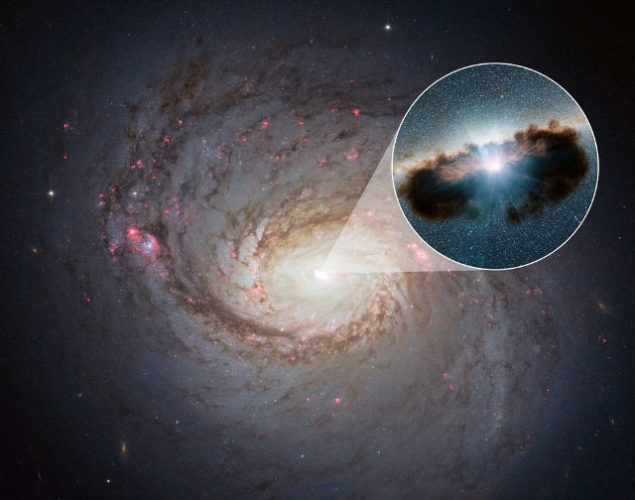
The galaxy NGC 1068 with its active galactic nucleus (Image NASA/JPL-Caltech)

An article published in the journal “Nature Astronomy” describes a research about the relationship between Active Galactic Nuclei (AGNs) and the galaxies that host them. Cristina Ramos Almeida of the Instituto de Astrofísica de Canarias (IAC) and Claudio Ricci of the Institute of Astronomy of the Universidad Católica de Chile used data collected by various space and ground-based telescopes to understand the effect of that activity, called in jargon AGN feedback, which can manifest in different ways, favoring or inhibiting star formation in their galaxies.

The star U Antliae with its gas bubble (Image ALMA (ESO/NAOJ/NRAO)/F. Kerschbaum)

An article published in the journal “Astronomy & Astrophysics” describes a research on U Antliae, a rather exotic red giant star. A team of researchers used the ALMA radio telescope to study the bubble of ejected materials that surrounds U Antliae to better understand the evolution of stars in the last stages of their life cycle. That’s a turbulent period in which they can visibly change their volume and their brightness in relatively short times.

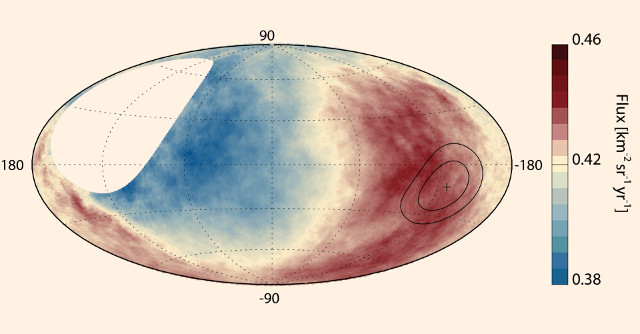
Map of cosmic ray flux (Image courtesy Pierre Auger Collaboration)

An article published in the magazine “Science” describes a research on the distribution of cosmic rays’ arrival directions. The Pierre Auger Collaboration used data collected by the Pierre Auger Observatory, Argentina, the largest ever built to detect cosmic rays, to find evidence that high energy cosmic rays come from outside the Milky Way.

Traces of the ancient rivers of Aeolis Dorsa (Image courtesy Cardenas et al)

An article published in the journal “GSA Bulletin” describes a research on the region of the planet Mars called Aeolis Dorsa. Benjamin T. Cardenas and other colleagues from the Jackson School of Geosciences at the University of Texas at Austin used images captured by space probes to determine the presence of traces of rivers that existed about 3.5 billion years ago. That region contains some of the most spectacular and dense river deposits on Mars.

Crater north of Hellas Planitia (Image ESA/DLR/FU Berlin, CC BY-SA 3.0 IGO)

ESA has published some images of a crater with more than 30 kilometers (about 20 miles) across north of the large Hellas Planitia basin on the planet Mars obtained thanks to the High Resolution Stereo Camera (HRSC) instrument of the Mars Express space probe. The appearance of the crater along with the river valleys to the south indicates that at the time of impact there was groundwater near the surface. This is another indication that there was a lake in that region.