Astronomy / Astrophysics

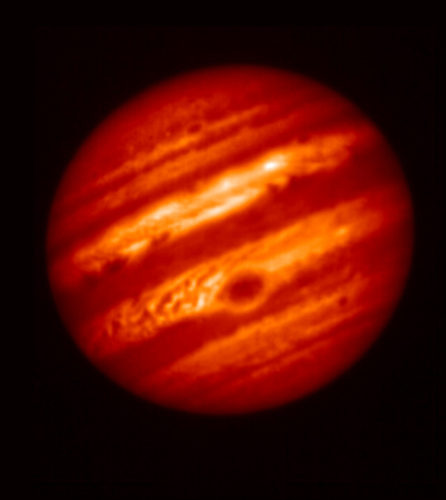
Jupiter seen by the Subaru telescope (Photo NAOJ/NASA/JPL-Caltech)

Two telescopes in Hawaii were used for new observations of the planet Jupiter and in particular of its famous Great Red Spot. They were conducted to support NASA Juno space probe’s mission, which on July 10 will fly over the giant jovian storm. The Gemini North telescope was used with special near-infrared filters to produce specific colors that can penetrate Jupiter’s upper atmosphere and clouds. The Subaru telescope’s COMICS instrument was used with mid-infrared filters.

The IRAS 04191+1523 system (Image ALMA (ESO/NAOJ/NRAO), Lee et al., ESA/Herschel/PACS)

An article published in the journal “Nature Astronomy” describes a study of the IRAS 04191+1523 system, consisting of two low-mass newborn stars. A team of astronomers led by Jeong-Eun Lee of Kyung Hee University, Korea, used the ALMA radio telescope to figure out how pairs of little stars form. The discovery that the two stars’ rotation axes are misaligned led them to conclude that a turbulence caused the fragmentation of the gas cloud from which they were born.

Betelgeuse seen by ALMA (Image ALMA (ESO/NAOJ/NRAO)/E. O’Gorman/P. Kervella)

An article published in the journal “Astronomy & Astrophysics” describes a study of the star Betelgeuse conducted using the ALMA radio telescope. This extraordinary instrument studied for the first time the surface of a star to get the highest resolution images ever obtained of Betelgeuse. This made it possible to obtain new data about its atmosphere and its asymmetries that will help to better understand red supergiants in the phases preceding a supernova.

Two supermassive black holes seen by VLBA (Image Bansal et al., NRAO/AUI/NSF.)

An article published in “The Astrophysical Journal” describes the discovery of the first pair of supermassive black holes orbiting each other at the center of the galaxy hosting them, called 0402+379. A team of astronomers used the Very Long Baseline Array (VLBA) radio telescope to locate the two black holes about 750 million light years from Earth. Their combined mass is about 15 billion times the Sun’s.

The galaxy cluster MACS J2129-0741 and the galaxy MACS2129-1 (Image NASA, ESA, and S. Toft (University of Copenhagen), M. Postman (STScI), and the CLASH team)

An article published in the journal “Nature” describes a study of the galaxy MACS 2129-1. An international team of researchers led by Sune Toft of the Niels Bohr Institute (NBI), University of Copenhagen, Denmark used the Hubble Space Telescope and ESO’s Very Large Telescope (VLT) to gather information about MACS 2129-1. The result is that no new stars are being formed and this is really surprising because it’s very far away so we see it as it was at a time when the universe was at the highest rate of star production.