Astronomy / Astrophysics

The explosion in the Orion Molecular Cloud 1 (Image ALMA (ESO/NAOJ/NRAO), J. Bally/H. Drass et al.)

An article published in “Astrophysical Journal” describes a research about the birth of a group of massive stars in the Orion Molecular Cloud 1 (OMC-1). A team of astronomers led by John Bally of the University of Colorado used the ALMA radio telescope to see inside the cloud and detect the debris scattered by that really chaotic event.

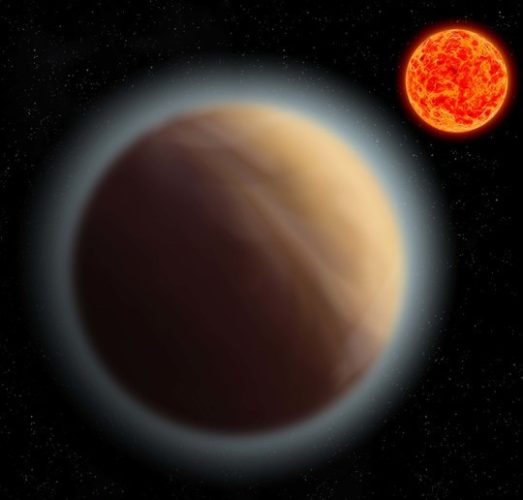
Artistic concept of the exoplanet GJ 1132b and its star (Image courtesy MPIA)

An article published in “The Astronomical Journal” describes a research about the exoplanet GJ 1132b. A team led by Dr. John Southworth of Keele University and by Italian INAF associate Luigi Mancini used the 2.2-meter ESO/MPG telescope in Chile to directly study this super-Earth during its transit in front of its star and detect its atmosphere. This is the first direct evidence of the existence of an atmosphere for a planet similar in size to Earth, although it could look more like Venus.

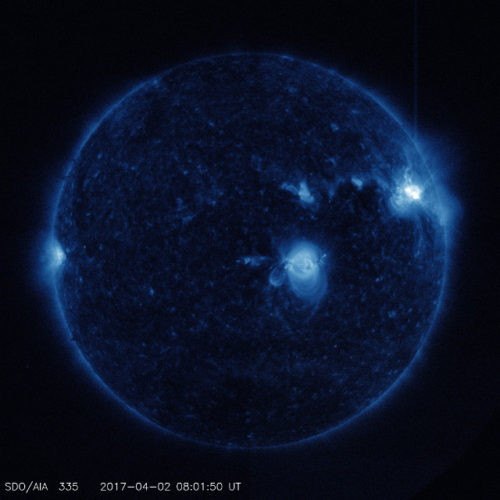
The Sun right before the first flare's peak (Photo NASA/SDO)

In recent days, NASA’s SDO (Solar Dynamics Obersavatory) space probe detected and documented 3 M-class solar flares, the class that includes the most powerful ones after the X-class, where X means “eXtreme”. The first one had its peak on April 2 at 8.02 UTC, the second one at 20.33 UTC and the third one on April 3 at 14:29 UTC.

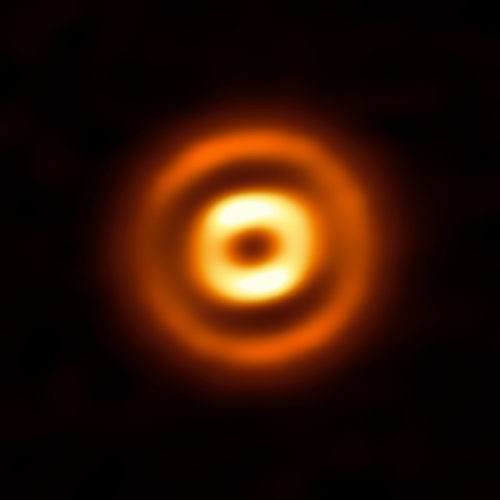
The HD 169142 system (Image ALMA (ESO/NAOJ/NRAO)/ Fedele et al.)

An article published in the journal “Astronomy & Astrophysics” describes the discovery of traces of two planets that are forming in the young system HD 169142. A team of researchers led by Davide Fedele of the Institute of Astrophysics in Florence, Italy, used the ALMA radio telescope to study the of gas and dust disk surrounding the young star identifying gap rings compatible with the formation of planets similar to Jupiter.

Artist's concept comparing Mars as it is today and as it was 4 billion years ago (Image NASA’s Goddard Space Flight Center)

An article published in the journal “Science” describes a research on the atmosphere of the planet Mars that indicates the Sun’s wind and radiation as the principal culprits of the fact that today that atmosphere is so thin. A team led by Bruce Jakosky, principal investigator of NASA’s MAVEN space probe’s mission, examined the measurements of the existing gases estimating for example that 65% of argon present origininally got lost in space. This research confirms the one published in November 2015.