Astronomy / Astrophysics

The M82 galaxy in Hubble's view on the left and the area of very intense star formation seen by Webb on the right

An article submitted for publication in “The Astrophysical Journal” reports a study of the exceptional rate of star formation in the M82 galaxy. A team of researchers led by Alberto Bolatto of the University of Maryland, College Park, used the James Webb Space Telescope to map powerful galactic winds that expel vast amounts of gas caused by star formation and supernova explosions.

The NIRCam instrument is the one used in particular to trace the origin of that activity back to dense star clusters in the galactic disk. This new study of M82 offers advances in understanding star formation and how this activity is affecting the galaxy.

The area around Sagittarius A*, the supermassive black hole at the center of the Milky Way, seen in polarized light

Two articles published in “The Astrophysical Journal Letters” report different aspects of a study of Sagittarius A*, or simply Sgr A*, the supermassive black hole at the center of the Milky Way, which led to the creation of an image in polarized light of the area around it. The Event Horizon Telescope (EHT) collaboration used again a combination of various radio telescopes to detect polarized light thanks to the fact that particles rotating around the magnetic field lines determine a polarization pattern perpendicular to it.

Dantu crater on the dwarf planet Ceres (Image courtesy Maria Cristina De Sanctis et al., Communications Earth & Environment, 2024)

An article published in the journal “Communications Earth & Environment” reports the discovery of ammonium-rich areas in the famous bright spots on the dwarf planet Ceres. A team of researchers composed of Maria Cristina De Sanctis, Filippo Giacomo Carrozzo, Mauro Ciarniello, Simone De Angelis, Marco Ferrari, Alessandro Frigeri, and Andrea Raponi from the Italian National Institute of Astrophysics’ Institute of Space Astrophysics and Planetology in Rome and Eleonora Ammanito of the Italian Space Agency examined data collected by NASA’s Dawn space probe focusing on Dantu crater to identify these compounds, which include a new ammonium salt.

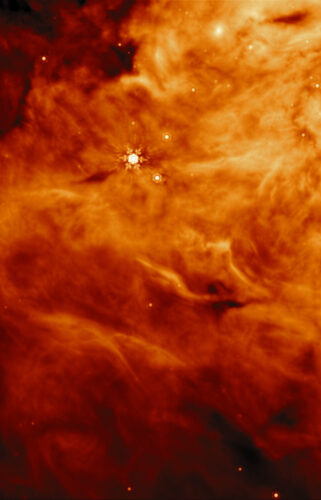
A region of a molecular cloud (Image ESA/Webb, NASA, CSA, W. Rocha et al. (Leiden University))

An article published in the journal “Astronomy & Astrophysics” reports the discovery of various complex organic molecules such as ethanol among the icy materials surrounding two protostars. A team of researchers used the James Webb Space Telescope’s Mid-Infrared Instrument (MIRI) to identify icy organic compounds around the low-mass protostar NGC 1333 IRAS 2A, or simply IRAS 2A, and the high-mass protostar IRAS 23385+ 6053, or simply IRAS 23385. Various molecules constitute building blocks for Earth-like life forms that could be like “seeds” on planets still in the process of formation.

Some of the systems observed with the VLT and represented here not in scale to appear similar in size

Three articles published in the journal “Astronomy & Astrophysics” report different aspects of a large study of 86 protoplanetary disks located in three different regions of the Milky Way. Teams of researchers with several shared members used the SPHERE instrument mounted on ESO’s Very Large Telescope (VLT) in Chile as part of the GTO and DESTINYS observation programs. The findings offer a treasure trove of information about planetary formation in the cosmic neighborhood that could lead to advances in current models and aid follow-up studies.