Astronomy / Astrophysics

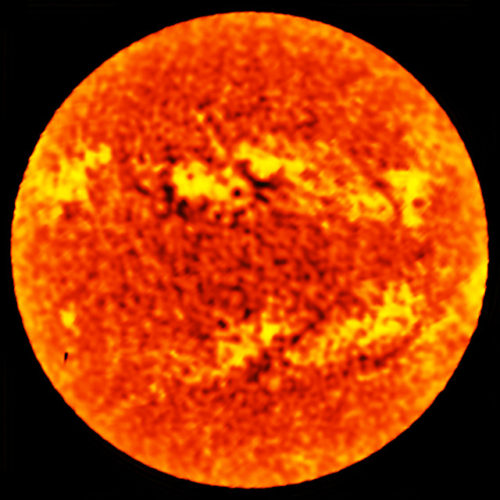
The solar disc seen by ALMA (Image ALMA (ESO/NAOJ/NRAO))

The first images of the Sun generated by observations carried out using the ALMA radio telescope have been published. This is the first time that the largest radio telescope in the world has been used in this way and this is the beginning of an important expansion in ALMA’s use. The first results are details of the Sun’s chromosphere such as a sunspot twice the size of Earth.

Elements of life

At the 229th Meeting of the American Astronomical Society held recently, astronomers of the SDSS/APOGEE project announced the results of a study that included more than 150,000 stars in the Milky Way. Each star was analyzed to determine the amount of nearly two dozen chemical elements, including carbon, hydrogen, nitrogen, oxygen, phosphorus and sulfur, the ones that form life’s building blocks.

The galaxy RX J1140.1+0307 (Photo ESA/Hubble & NASA. Acknowledgement: Judy Schmidt)

A photo taken by the Hubble Space Telescope shows the galaxy RX J1140.1+0307 and apparently it’s a spiral galaxy like there are a lot, including the Milky Way. However, normally these galaxies have at their center a supermassive black hole, instead RX J1140.1+0307 has a smaller, intermediate-mass black hole. This is an anomaly and astronomers are looking for an explanation.

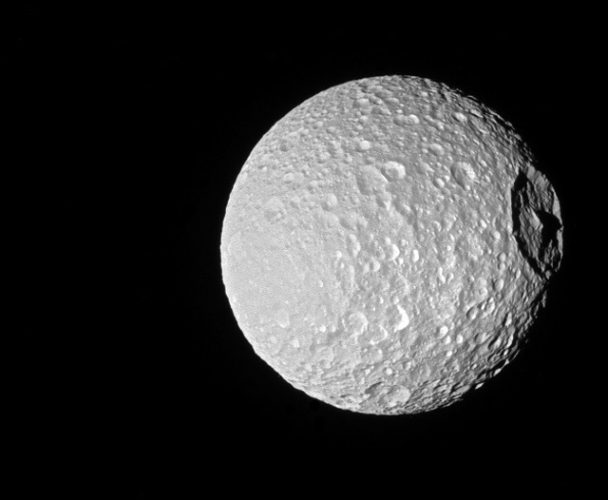
The big Mimas' mountain seen by the Cassini space probe

NASA has published a new photo taken by the Cassini space probe of Mimas, one of Saturn’s moons, which provides an excellent perspective view of the mountain in the center of Herschel crater, which is not huge in absolute terms but has a diameter which is almost a third of that of Mimas. The mountain is high even by Earth standards with at least 6 kilometers (4 miles) above the crater’s floor and stands out even more on the small moon.

Pluto and Charon (Image NASA-JHUAPL-SwRI))

An article published in the journal “Icarus” describes a research on Charon, the biggest moon of the dwarf planet Pluto, and on one aspect of the relationship between the two of them. A team of researchers at the Georgia Institute of Technology made a series of computer simulations that indicate that the passage of Charon between Pluto and the Sun slows the dwarf planet’s atmosphere loss. The predictions are consistent with the data collected by NASA’s New Horizons space probe.