
Astronomy / Astrophysics

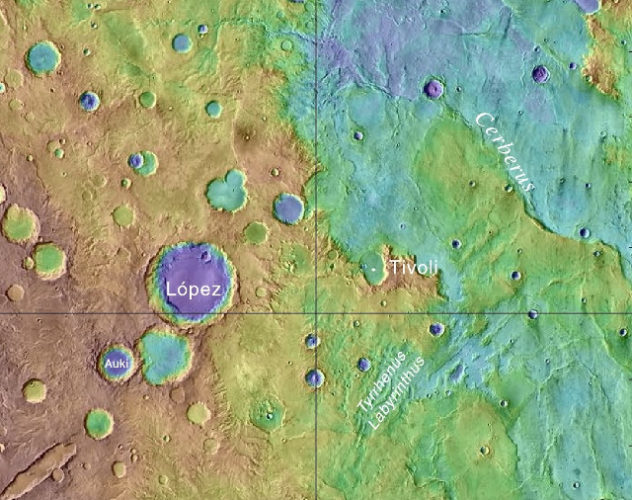
The area around the Auki crater (Image NASA/USGS)

An article published in the journal “Icarus” describes new evidence of ancient hydrothermal activity presence in the Auki Crater on Mars. A team of scientists led by Filippo Giacomo Carrozzo of INAF-IAPS, Rome, Italy, used images and spectroscopic data collected by NASA’s Mars Reconnaissance Orbiter (MRO) space probe to identify geological structures and mineral hydrates that confirm that hypothesis.

The region around Sagittarius A* (Image X-ray: NASA/UMass/D.Wang et al., IR: NASA/STScI)

An article published in the journal “Physical Review Letters” describes a research on Sagittarius A*, the supermassive black hole at the center of the Milky Way. A team of scientists from the University of Princeton and the US Department of Energy’s Princeton Plasma Physics Laboratory (PPPL) developed a new method to create a model of the accretion disk which feeds Sagittarius A*.

IRAS 16399-0937 (Image ESA/Hubble & NASA. Acknowledgement: Judy Schmidt (geckzilla))

An image obtained thanks to observations made by the Hubble Space Telescope shows a very peculiar galaxy. Called IRAS 16399-0937, it’s a megamaser, which is an astronomical maser that emits microwaves with an intensity about a hundred million times greater than that of astronomical masers found in galaxies like the Milky Way. That’s because virtually all the galaxy is a maser.

The nebula NGC 6357 (Image X-ray: NASA/CXC/PSU/L. Townsley et al; Optical: UKIRT; Infrared: NASA/JPL-Caltech)

NASA has released an image that’s stunning even by its standards of nebula NGC 6357. The colors are the result of a composition obtained by putting together X-ray data from Chandra X-ray Observatory and the ROSAT space telescope, the infrared data from NASA’s Spitzer space telescope and optical data from the SuperCosmos Sky Survey.

Possible Proxima Centauri orbit. The numbers are in millennia (Image P. Kervella (CNRS/U. of Chile/Observatoire de Paris/LESIA), ESO/Digitized Sky Survey 2, D. De Martin/M. Zamani)

An article published in the journal “Astronomy and Astrophysics” describes the observations that led to conclude that the star Proxima Centauri orbits Alpha Centauri A and B forming a triple system. Astronomers Pierre Kervella, Frederic Thevenin and Christophe Lovis used the HARPS instrument installed at ESO’s La Silla observatory in Chile to obtain the precise measurements needed to support this theory.