Astronomy / Astrophysics

A part of the IRAS 16562–3959 area (Image ESA/Hubble & NASA, R. Fedriani, J. Tan)

An image captured by the Hubble Space Telescope shows a part of the star-forming area cataloged as IRAS 16562–3959. The Wide Field Camera 3 (WFC3) instrument offers many details of that area at infrareds, in particular of the emissions coming from a massive star still in its formation phase whose consequences are visible in the part of the image that goes from the center towards the upper left and lower right. These and many other details can help reconstruct star formation processes.

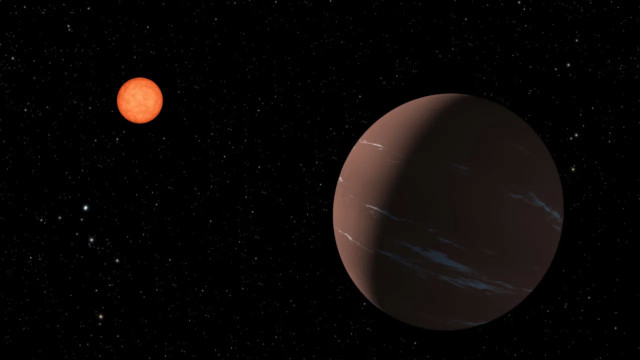
Artist's concept of the exoplanet TOI-715b with its star in the background (Image NASA / JPL-Caltech)

An article published in the journal “Monthly Notices of the Royal Astronomical Society” reports the identification of the exoplanet TOI-715 b in an orbit around its star in a position that meets the most conservative definition of a habitable zone. A team of researchers used observations conducted with NASA’s TESS space telescope confirmed by other instruments to identify what appears to be a super-Earth with a radius about 1.5 times the Earth’s. A second exoplanet candidate was discovered that would have a size very similar to the Earth’s a little further away from its star but follow-up observations are needed to verify that it’s not a false positive.

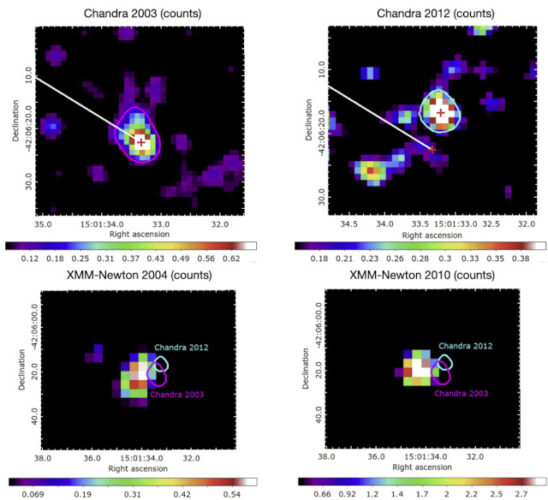
Four X-ray observations of the supernova remnants SN 1006

An article published in the journal “Astronomy & Astrophysics” reports a study of the supernova remnant cataloged as SN 1006 which led to the identification of an ejecta fragment of the progenitor star. A team of researchers led by Roberta Giuffrida of the University of Palermo and the Italian National Institute of Astrophysics used observations conducted with various telescopes exploiting X-ray emissions and compared them with theoretical models. The conclusion is that this iron-rich fragment is moving at a very high speed within the debris cloud generated by the supernova. This discovery is useful in the study of supernovae like this one, generated by explosions of white dwarfs.

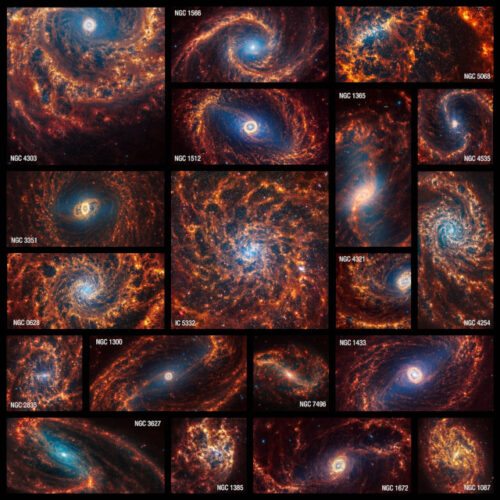
Mosaic of the 19 spiral galaxies studied by the PHANGS project

The images of 19 spiral galaxies captured by the James Webb Space Telescope have been released as part of the PHANGS (Physics at High Angular resolution in Nearby GalaxieS) project. These are galaxies up to 65 million light-years away that we see face-on, and this allows to better observe the stars inside them, an optimal situation for a project focused on star formation processes. Webb’s NIRCam (Near-Infrared Camera) and MIRI (Mid-Infrared Instrument) instruments were employed to cover the near and mid-infrared resulting in many new details.

LEDA 60847 (Image NASA/ESA/A. Barth (University of California - Irvine)/M. Koss (Eureka Scientific Inc.)/A. Robinson (Rochester Institute of Technology)/Processing: Gladys Kober (NASA/Catholic University of America))

An image captured by the Hubble Space Telescope shows LEDA 60847, a group of interacting galaxies. The largest galaxy has an active galactic nucleus (AGN) with a supermassive black hole surrounded by materials that are heated to the point of generating the electromagnetic emissions behind its luminosity. This galaxy is interacting with its neighbors and in a very long time, they will form a single larger galaxy.