Astronomy / Astrophysics

Two different articles, one to be published in the journal “Icarus” and one published in the journal “Monthly Notices of the Royal Astronomical Society”, describe different aspects of a study that offers a new model to describe the tidal effects that might cause fractures on the surface of icy moons. According to a University of Rochester team led by Alice Quillen the tidal effects of a close encounter could explain very extensive fractures.

Representation of a solar superflare (Image NASA's Goddard Space Flight Center, Greenbelt, Md.)

An article published in the journal “Nature Geoscience” describes a study on the relationship between super solar flares of a few billion years ago and the emergence of life forms on Earth. According to a team of NASA scientists led by Vladimir Airapetian those gigantic storms provided the energy needed to warm up the Earth and to trigger some chemical reactions needed to form complex molecules such as RNA and DNA on which life is based.

Artistic representation of a supermassive black hole seed. The inset boxes show a candidate seen by Chandra (top) and by Hubble (bottom) (Image X-ray: NASA/CXC/Scuola Normale Superiore/F. Pacucci, et al. Optical: NASA/STScI. Illustration: NASA/CXC/M. Weiss)

An article that will be published in the journal “Monthly Notices of the Royal Astronomical Society” describes a research on the origin of supermassive black holes. A team of Italian scientists led by Fabio Pacucci of Scuola Normale Superiore of Pisa used NASA’s space telescopes to identify two ancient objects that represent the best candidates black hole “seeds” found so far.

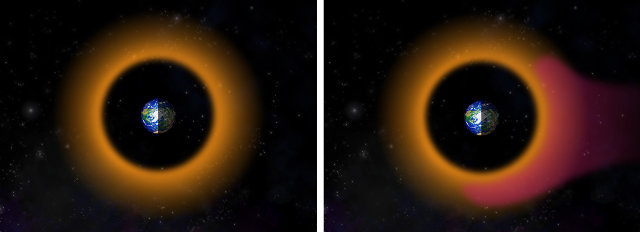
The ring current during quiet time (left) and during a geomagnetic storm (right) (Image Johns Hopkins APL)

An article published in the journal “Geophysical Research Letters” describes a research on the behavior of the ring of particles that surrounds the Earth. Using the measurements taken by the RBSPICE instrument aboard one of NASA’s Van Allen space probes it was possible to establish that high-energy protons in the ring current behave completely different from low-energy protons. It’s a step forward in the understanding of the Earth’s magnetosphere and therefore of the effects it may have on satellites and even the Earth’s surface.

The area that includes Chryse Planitia, Acidalia Planitia and Arabia Terra (a,c) with the close-up of a promontory (c) (Image J. Alexis Palmero Rodriguez)

An article published in the journal “Nature” presents a study that describes two possible mega-tsunamis that shook the surface of the planet Mars more than three billion years ago. According to a team led by J. Alexis Palmero Rodriguez of the Planetary Science Institute two meteorites hit Mars a few million years from each other but with similar effects. Perhaps at that time there was an ocean of liquid water and the impacts raised waves up to 120 meters (almost 400 fett) which engulfed large areas of the mainland.