Astronomy / Astrophysics

Picture taken by the Hubble Space Telescope with the galaxy GN-z11 in the inset (Image NASA, ESA, and P. Oesch (Yale University))

An article about to be published in “The Astrophysical Journal” describes the discovery of the most distant galaxy observed so far. Called GN-z11, it’s about 13.4 billion light years from Earth and that means that we’re seeing the light emitted when the universe was about 400 million years. An international team of astronomers pushed the Hubble Space Telescope to the limit of its possibilities to achieve this result.

A portion of space simulated by the Illustris project showing the distribution of dark matter (Image courtesy Markus Haider / Illustris collaboration)

An article published in the journal “Monthly Notices of the Royal Astronomical Society” describes a research on the distribution of matter in the universe. According to the results 20% of ordinary matter is contained in the so-called cosmic voids and galaxies are only 1/500th of the volume of the universe. A team led by Dr Markus Haider of the Institute of Astro and Particle Physics at the University of Innsbruck in Austria, has used simulations of the Illustris project to reach these conclusions.

Aerial view of the Arecibo radio telescope (Photo H. Schweiker/WIYN and NOAO/AURA/NSF)

An article published in the journal “Nature” describes a study following the discovery of repeating fast radio bursts. For the first time, this kind of phenomenon repeated and a team of researchers led by Laura Spitler of the Max Planck Institute for Radio Astronomy in Bonn, Germany, was able to identify a sequence of signals coming from the same source using the Arecibo radio telescope.

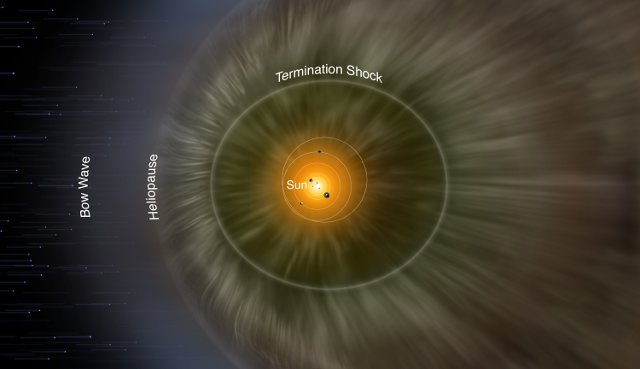
Artistic representation of the heliosphere with its heliopause and termination shock (Image NASA/IBEX/Adler Planetarium)

An article published in the journal “Astrophysical Journal Letters” describes a study that used data from NASA’s IBEX space probe and various simulations of the boundary of the magnetic bubble called the heliosphere, created by the flow of particles emitted by the Sun, to improve our knowledge of the interstellar magnetic field. In particular, this study sought to determine the strength and direction of the magnetic field outside the heliosphere to understand the forces acting in the galactic neighborhood.

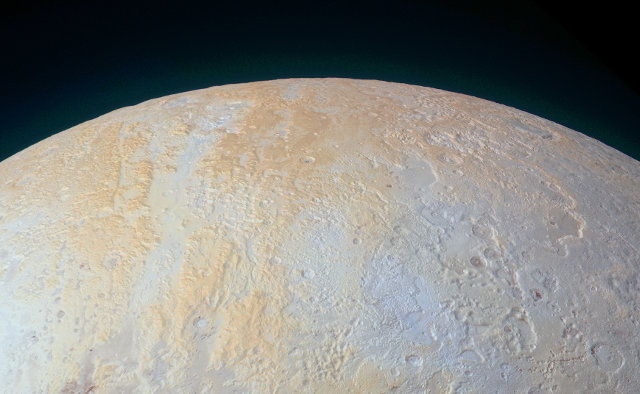
The area around Pluto's North Pole (Image NASA/JHUAPL/SwRI)

NASA’s New Horizons space probe sent photographs of the area around the dwarf planet Pluto’s north pole taken during the extraordinary July 14, 2015 flyby. The images reveal a series of canyons long and wide in the polar area that at its bottom is about 1,200 km (750 miles) wide. It’s part of the region informally called Lowell Regio after the astronomer Percival Lowell, the founder of the observatory where Pluto was discovered.