
Astronomy / Astrophysics

The dwarf galaxy IC 1613 photographed by the OmegaCAM on ESO's VST (Image ESO)

The OmegaCAM camera mounted on ESO’s VST (VLT Survey Telescope) was used to take a picture of the dwarf galaxy IC 1613. It has the distinction of being really clean, meaning that it contains very little dust while most galaxies contain dust clouds or are even full of it. The very low dust content of IC 1613 allows astronomers to observe its inside and is therefore an excellent target for astronomy and astrophysics studies.

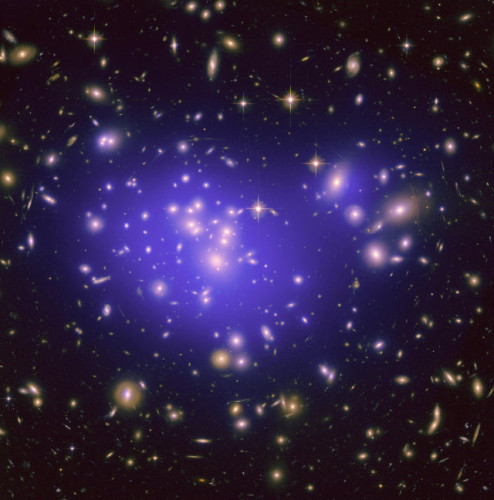
The Abell 1689 galaxy cluster

An article published in the journal “Physical Review Letters” offers clues about the link between the internal structure of a galaxy cluster and the dark matter environment surrounding it. The study of dark matter is complex because it can only be done indirectly due to the fact that we can’t detect it directly. Until now, scientists believed that the greater the mass of a cluster the greater the amount of dark matter in its environment. This new research suggests that things are more complicated.

Image of the Trumpler 14 cluster obtained combining photos taken by the Hubble Space Telescope (Image NASA, ESA, and J. Maíz Apellániz (Institute of Astrophysics of Andalusia, Spain), Acknowledgment: N. Smith (University of Arizona))

The Hubble Space Telescope was used to capture the details of of the Trumpler 14 open cluster. This is one of the largest groups of stars that are massive and as a consequence very bright in the Milky Way. It’s a young cluster in astronomical terms as its aged is about half a million years. It has a diameter of about six light years and within it about 2,000 stars of very diverse masses were identified.

Illustration of our traditional view of the Van Allen belts (Image NASA Goddard/Duberstein)

An article published in “Journal of Geophysical Research” describes a study on the Van Allen belts, two donut-shaped energetic formations surrounding the Earth. Two twin spacecraft originally called the Radiation Belt Storm Probes (RBSP) and later Van Allen probes were launched by NASA on August 30, 2012 to study the belts and are allowing us to learn a lot about them. The latest discovery concerns the variability of their shape.

Artistic concept of the quasar galaxy W2246-0526 (Image NRAO/AUI/NSF; Dana Berry / SkyWorks; ALMA (ESO/NAOJ/NRAO))

The ALMA radio telescope allowed us to study the extraordinary events taking place in the galaxy W2246-0526, the brightest we know. It’s a quasar because its core is powered by a supermassive black hole that has a considerable activity that generates enormous jets of particles and high-energy radiation. This one in particular is part of a special category of quasars because it’s full of dust that absorbs a lot of radiation. However, the consequence of this activity is a turbulent activity that is expelling the gas.