Astronomy / Astrophysics

Artistic concept of an aurora at the north pole of a brown dwarf (Image Chuck Carter and Gregg Hallinan/Caltech)

Its aurora is 10,000 times more powerful than any other ever seen, somuch as to be detectable, although with very sophisticated instruments, from a distance of 18 light years. It was found on a brown dwarf called LSR J1835+3259 using the Karl G. Jansky Very Large Array (VLA), the Hale Telescope in California and the Keck Telescope in Hawaii. The results of this research have just been published in the journal “Nature”.

Photo of the surface of the area of the comet 67P/Churyumov-Gerasimenko known as Agilkia taken by the Philae lander from a 9 m height (Photo ESA/Rosetta/Philae/ROLIS/DLR)

A special issue of the journal “Science” describes an early analysis of data collected by the lander Philae in its descent to the surface of the comet 67P/Churyumov-Gerasimenko. Its mission was short and ESA engineers can’t get a stable contact after those of recent weeks but the data collected were very helpful. Another very interesting study just appeared about the interaction of the comet with the solar wind.

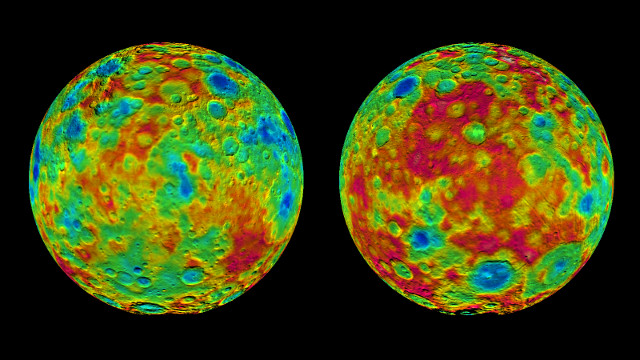
Topographic map of the dwarf planet Ceres (Image NASA/JPL-Caltech/UCLA/MPS/DLR/IDA)

NASA published the first topographic maps of the dwarf planet Ceres made using data collected by its Dawn space probe. They show a very diverse surface, full of craters and mountains with differences between the bottom of the craters and the mountain peaks that can reach 15 kilometers (about 9 miles). Meanwhile, the IAU (International Astronomical Union) approved a series of names for various geological features of Ceres.

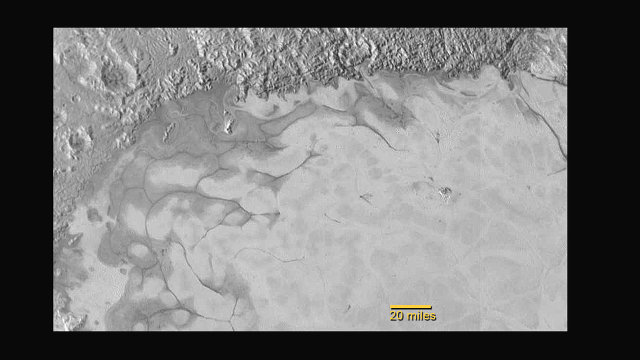
Area on Pluto where there are flowing glaciers (Photo NASA/JHUAPL/SwRI)

The scientists working at NASA’s New Horizons mission keep on analyzing the photographs that the spacecraft is sending after its July 14, 2015 flyby with the dwarf planet Pluto. The ones received in recent days show that in the heart-shaped area there are flowing glaciers and that in the atmosphere there are thick layers of haze that reach an altitude of 130 kilometers (about 80 miles).

A comparison of the Kepler-452 system with the solar system and the Kepler-186 system (Image NASA/JPL-CalTech/R. Hurt)

NASA announced the discovery of the planet Kepler-452b made using the Kepler space telescope. It has an orbit similar to that of the Earth around a star similar to the Sun. This puts it well within the habitable zone of its star system because the star Kepler-452 is just a little bigger and brighter than the Sun so if on the planet Kepler-452b there was an atmosphere similar to the Earth’s, water could exist in liquid form.