Astronomy / Astrophysics

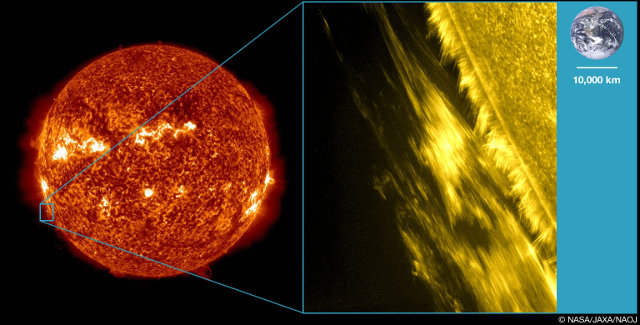
On the left a picture of the Sun taken by the SDO space probe, at the center a close-up of a prominence and on the right a picture of the Earth in the same scale (Image NASA/JAXA/NAOJ)

Two articles published in “The Astrophysical Journal” describe a study of what is known as the coronal heating problem. For decades, scientists have been trying to understand why the temperature on the surface of the Sun is about 6,000 Kelvin while the corona, the region between the surface and the area of ​​the outer atmosphere, can reach temperatures of several million degrees. Now a team of researchers led by Takenori Okamoto of the Solar-Terrestrial Environment Laboratory at Nagoya University and ISAS/JAXA and Patrick Antolin of the National Astronomical Observatory of Japan, Tokyo, offers an explanation, tied to resonant absorption.

Picture of the lonly mountain on Ceres taken by the Dawn space probe (Photo NASA/JPL-Caltech/UCLA/MPS/DLR/IDA)

NASA’s Dawn spacecraft is carrying out a mapping of the dwarf planet Ceres and with its camera is capturing extraordinary images better than those available so far, with a resolution of 140 meters (450 feet) per pixel. Among the geological features photographed there’s a mountain about 6 kilometers (4 miles) high that had already intrigued scientists and public because it looks like a pyramid and its sides are covered with brilliant material.

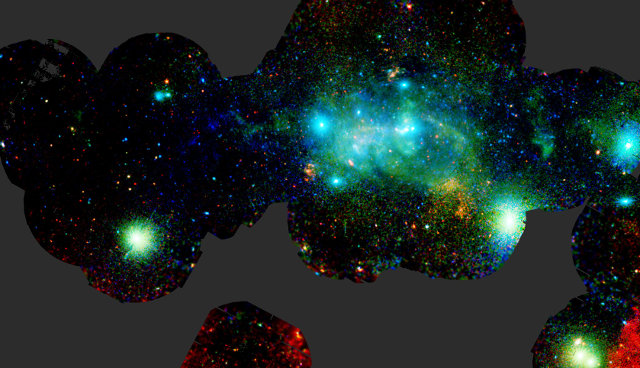
X-ray view of the Milky Way center (Image ESA/XMM-Newton/G. Ponti et al. 2015)

An article published in the journal “Monthly Notices of the Royal Astronomical Society” describes a research about the central region of the Milky Way. Using ESA’s XMM-Newton X-ray space observatory, a team of scientists from the Max Planck Institute for Extraterrestrial Physics (MPE) led by Dr. Gabriele Ponti revealed the most intense processes going on at the center of the galaxy.

Examples of the fractures detected on the surface of the comet 67P/Churyumov-Gerasimenko (Image ESA/Rosetta/MPS for OSIRIS Team MPS/UPD/LAM/IAA/SSO/INTA/UPM/DASP/IDA)

While the comet 67P/Churyumov-Gerasimenko started moving away from the Sun, new studies have been published based on data collected over the past months. An article published in the journal “Geophysical Research Letters” describes the exam of the many fractures photographed after the arrival of ESA’s space probe Rosetta. Another article published in the journal “Annales Geophysicae” provides an explanation for the “song” of the comet discovered last year.

Picture of the galaxy NGC 428 taken by the Hubble Space Telescope (Photo ESA/Hubble and NASA and S. Smartt (Queen's University Belfast))

A photograph of the galaxy NGC 428 taken by the Hubble Space Telescope shows its distorted and warped structure. Together with traces of a significant amount of stars being formed, it’s the sign of the merger between two galaxies. For this reason, its appearance could give us an idea of ​​what will happen in a few billion years to the Milky Way in its merger with Andromeda.