
Astronomy / Astrophysics

Artistic concept of the Phoebe ring with Saturn and the other rings in the middle (Image Credit: NASA/JPL/Space Science Institute)

An article published in the journal “Nature” describes a research that has revealed the size of the outer ring of the planet Saturn. It’s called Phoebe ring because it’s believed to have been created by dust particles coming from Phoebe, one of Saturn’s moons, as a result of impacts that projected them into space. This ring was discovered in 2009 and immediately its enormous size was noted. This new research using infrared images obtained from NASA’s WISE space telescope shows that it’s even larger than previously thought.

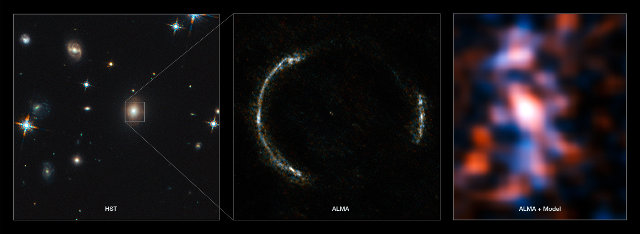
Pictures of the galaxy SDP.81. On the left a picture taken by the Hubble Space Telescope. In the middle, the galaxy as an Einsetin ring and on the left as it's seen after being processed to eliminate the gravitational lensing distorsion (Image ALMA (NRAO/ESO/NAOJ)/Y. Tamura (The University of Tokyo)/Mark Swinbank (Durham University))

ESO’s telescope ALMA (Atacama Large Millimeter / submillimeter Array) in Chile allowed to take the most detailed images ever obtained of a galaxy called HATLAS J090311.6+003906 or SDP.81. It’s about 11.4 billion light years from Earth and its light is distorted by the phenomenon called gravitational lensing. A galaxy between it and the Earth distorts its light with its huge gravity and the result is that we see an almost perfect ring, called an Einstein ring.

The Pluto system (Image NASA/STScI/Showalter)

An article just published in the journal “Nature” describes a research on Pluto and its moons showing how two of them, Nix and Hydra, spin in an uncontrolled and unpredictable way. This study is based on an analysis of the observations made using the Hubble Space Telescope but because of the considerable distance they’re far from complete. For this reason, it’s possible that the two other small moons of Pluto, Styx and Kerberos, are in the same situation.

Picture of the comet 67P/Churyumov-Gerasimenko taken by the Rosetta space probe on May 20, 2015 that shows gas jets coming from its nucleus (Photo ESA/Rosetta/NavCam)

The journal “Astronomy and Astrophysics” will publish an article that illustrates a discovery about the atmosphere of the comet 67P/Churyumov-Gerasimenko generated by the sublimation of the ice it contains. Water, but also carbon dioxide, are turned into steam but thanks to the instrument Alice of the space probe Rosetta it was possible to discover that these molecules get broken and that this happens in two stages.

Artistic concept of a galaxy generatic relativistic jets with radio waves coming from its supermassive black hole (Image ESA/Hubble, L. Calçada (ESO))

An article published in the journal “Astrophysical Journal” describes a study that established a link between the presence of supermassive black holes that emit jets of materials to nearly the speed of light but also radio waves and galaxy mergers. An international team of astronomers led by Italian INAF researcher Marco Chiaberge used the Hubble Space Telescope in the most extensive survey of the kind ever conducted.