Astronomy / Astrophysics

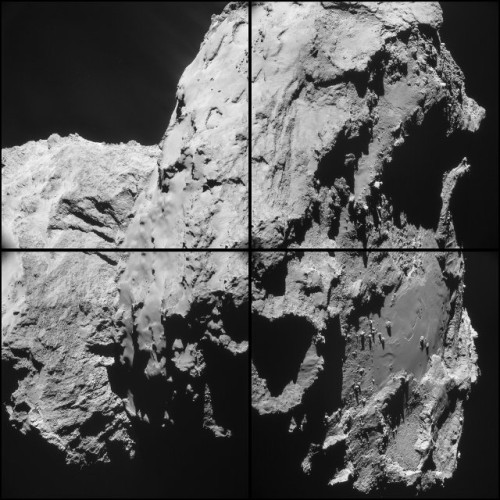
Four image montage of pictures of the comet 67P/Churyumov–Gerasimenko taken by the space probe Rosetta (Image ESA/Rosetta/NAVCAM)

During the past weekend, ESA’s space probe Rosetta has taken a new flyby about 14 kilometers (about 8.6 miles) away from the comet 67P/Churyumov-Gerasimenko. This means that it hasnt come as close as in February, however, the comet’s increasing activity caused some problems in Rosetta. Among the consequences, it had serious difficulties in communicating with ESA’s mission control.

The Planck all-sky map at submillimetre wavelengths with the protoclusters indicated as black dots. The inset images showcase some of the observations made by Herschel’s SPIRE instrument (Image ESA and the Planck Collaboration/ H. Dole, D. Guéry & G. Hurier, IAS/University Paris-Sud/CNRS/CNES)

An article published in the journal “Astronomy & Astrophysics” describes the results of a research carried out by combining the observations made with ESA’s Herschel and Planck space telescopes. The purpose was to find protoclusters, the precursors of today’s galaxy clusters seen in the distant past when the universe was only three billion years. This will help to understand how these huge groups of tens, hundreds and even thousands of galaxies formed and evolved.

Data from the SOFIA airborne telescope shows dust surviving within a supernova remnants (Image NASA/CXO/Herschel/VLA/Lau et al)

In the journal “Science” an article was just published that discusses a research conducted by an international team of scientists who found evidence that supernovae can generate a sufficient amount of material that can later create new planets like Earth. This team, led by Ryan Lau of Cornell University in Ithaca, New York, studied in particular a supernova that exploded about 10,000 years ago using a special instrument, the airborne telescope SOFIA.