Astronomy / Astrophysics

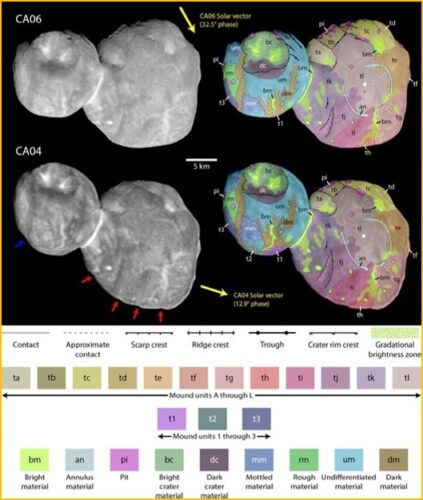
A mosaic of photos of Arrokoth taken by the New Horizons space probe's LORRI instrument on the left and a geologic map of the asteroid on the right

An article published in the journal “The Planetary Science Journal” reports a study on the mound-like formations found on asteroid Arrokoth by NASA’s New Horizons space probe. The images collected show that especially the largest lobe, which was named Wenu, is dominated by these geological features but the smaller lobe, which was named Weeyo, has some of them as well. A team of researchers led by Alan Stern conducted simulations that indicate that these are the traces of smaller bodies that coalesced in the very early history of the solar system. This offers new insights into the formation mechanisms not only of asteroids but also of larger rocky bodies.

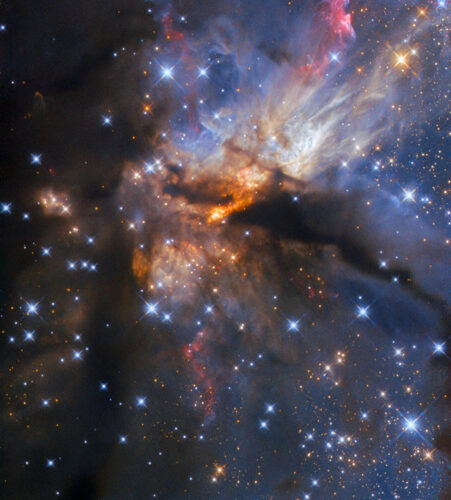
The G35.2-0.7N region (Image ESA/Hubble & NASA, R. Fedriani, J. Tan)

An image captured by the Hubble Space Telescope depicts the star-forming region cataloged as G35.2-0.7N, in which massive stars form. Protostars are surrounded by cocoons of gas and dust which in turn are inside larger clouds, and that usually makes them invisible. However, one of those protostars near the center of the image is emitting jets of materials that illuminate the region and dig into the gas, allowing some of the protostellar light to escape.

About 7,200 light-years away from Earth, the G35.2-0.7N region is of interest to astronomers who are studying the processes that lead to the birth of stars. The Hubble Space Telescope’s Wide Field Camera 3 (WFC3) instrument is one of many that have been used over time in various studies taking photos that have now been assembled into a single image.

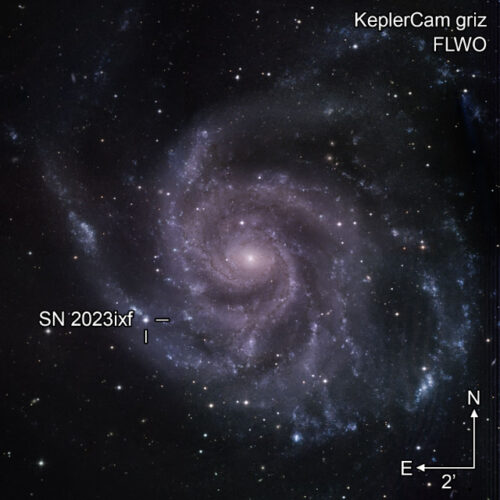
An image of the Pinwheel Galaxy with the location of supernova 2023ixf captured on June 27, 2023, using various optical and infrared frequency filters

Two articles published in “The Astrophysical Journal Letters” report as many studies on the supernova cataloged as SN 2023ixf. Two teams of researchers with members in common examined the evolution of this supernova discovered in the so-called Pinwheel Galaxy. To do this, they used various instruments including some from the Center for Astrophysics (CFA) Harvard & Smithsonian which allowed observations in different electromagnetic bands. The results were different from what was expected from the explosion of a massive star with a delay in the time of the peak of the light pulse just before the explosion. The conclusion is that this was due to the presence of dense materials ejected from the star in the year preceding the supernova.

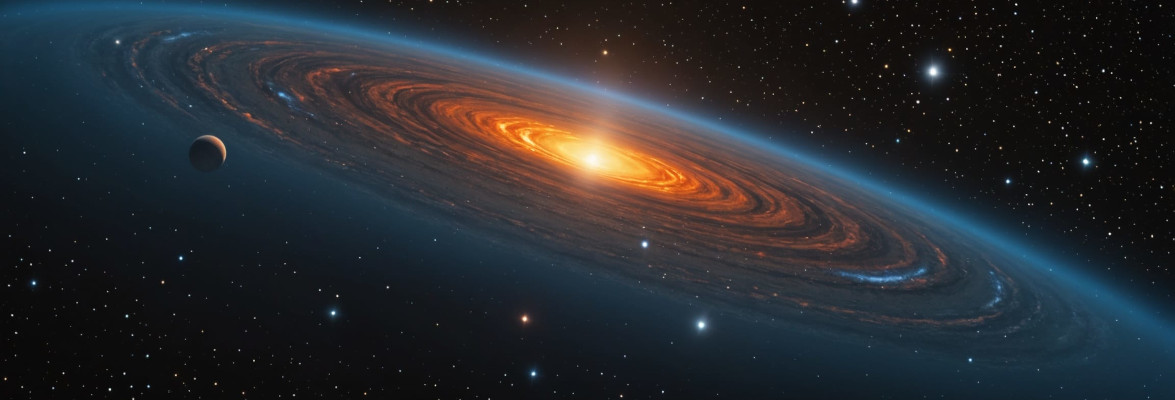
Artist's illustration of the exoplanet Tahay / GJ 367 b (Image NASA)

An article published in “The Astrophysical Journal Letters” reports a study on the exoplanet GJ 367 b, or Gliese 367 b, formally known by the name Tahay, which concludes that its core is composed almost entirely of iron for a density that is almost twice the Earth’s. The researchers also announced the discovery of two more planets in the system of the star GJ 367, formally known as Añañuca, which may be super-Earths.

Just over 30 light-years from Earth, Añañuca is a red dwarf with a mass and size just under half of the Sun’s. Observations began in 2019 with NASA’s TESS space telescope and in 2021 the data collected led to the exploration of the possibility that a planet orbited very close to this star, subsequently confirmed with other instruments. Tahay’s roughly 7.7-hour year is the shortest in the cosmic neighborhood, one reason for interest and worthy of its own name.

The capsule containting asteroid Bennu's samples (Image NASA TV)

A little while ago, the samples taken from the asteroid Bennu brought back to Earth by NASA’s OSIRIS-REx space probe were collected by the American space agency’s crew in the area of their landing, at the Utah Test and Training Range. They will be transported to the Johnson Space Center, the first stage of a series of operations needed to process them while avoiding their contamination. In this study, NASA is collaborating with the Japanese space agency JAXA, which will receive some of the samples to compare them with those collected by its own Hayabusa 2 space probe on the asteroid Ryugu and returned to Earth in December 2020.