Astronomy / Astrophysics

Artist's concept of the HD 45166 system with the helium star in the foreground (Image ESO/L. Calçada)

An article published in the journal “Science” reports a study that identifies one of the stars in the binary system HD 45166 as the likely precursor of a magnetar. A team of researchers led by Tomer Shenar of the University of Amsterdam used various telescopes to study a so-called helium star, a massive star that is nearing the end of its life and has already ejected its outer layers and is left with a core formed by helium on its surface. This star revealed an extremely powerful magnetic field, estimated to be about 100,000 times the Earth’s.

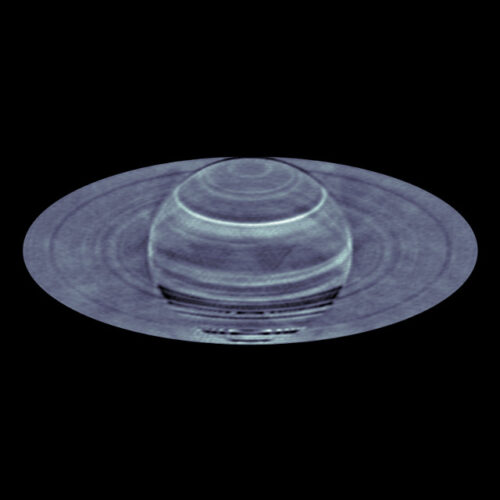
Saturn seen on radio waves from the VLA (Image S. Dvello (NRAO/AUI/NSF), I. de Pater et al (Berkeley))

An article published in the journal “Science Advances” reports a study on the megastorms active on the planet Saturn. A team of researchers used observations conducted with the VLA (Very Large Array) that allowed them to map the radio emissions coming from under Saturn’s surface and find anomalies in the distribution of ammonia gas. The conclusions of the study are that megastorms can last even a century and leave consequences that persist in the atmosphere even longer. This also shows differences from the giant storms existing on Jupiter.

On the left, the galaxy cluster WHL0137-08 and in the inset, the galaxy nicknamed the Sunrise Arc in its distorted form, which hosts the star Earendel

Two articles, one published in “The Astrophysical Journal” and one in “The Astrophysical Journal Letters”, report various aspects of a study of Earendel, the most distant single known star. Two teams of researchers with several members in common used observations conducted with the James Webb Space Telescope to obtain new details of this star, which even such a powerful instrument could only detect thanks to a gravitational lens. Officially cataloged as WHL0137-LS, the new study turns out to be a class B blue giant, much more massive than the Sun. Webb’s observations also reveal a luminous component that could belong to a less massive companion and not even the Hubble Space Telescope was able to detect.

The Ring Nebula (Image NASA/ESA/CSA/The University of Manchester)

An image captured by the James Webb Space Telescope shows the Ring Nebula, one of the most iconic planetary nebulae, in new details that reveal the complexity of the processes taking place during the last phase of the life of a small to medium star thanks to the NIRCam (Near Infrared Camera) instrument’s ability to detect infrareds. A team of researchers led by Mike Barlow of UCL (University College London) is studying the Ring Nebula as a target of the JWST Ring Nebula Project, of which Barlow is the lead scientist. The study is still ongoing, but Barlow stated that Webb’s high-resolution images not only show details of the expanding nebula’s shell but also reveal the inner region around the central white dwarf with exquisite clarity.

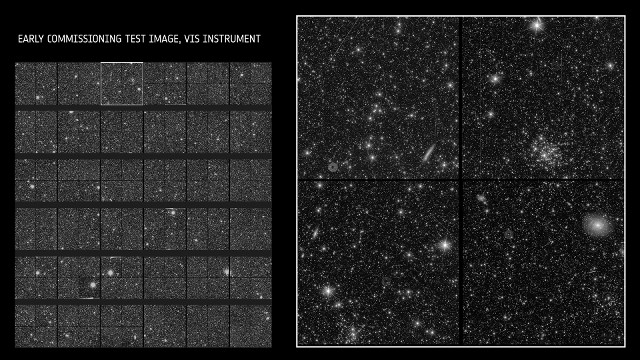
Early commissioning test image – VIS instrument full field of view and zoom in for detail

ESA has published the first test images captured by the Euclid Space Telescope. As soon as Euclid reached its destination, testing of both instruments, VIS and NISP, began and will continue for a couple of months to calibrate them until they reach optimal performance. They are necessary tasks to enable Euclid to conduct the scientific mission which consists of investigating the dark universe to try to solve some cosmological mysteries such as that of the acceleration of the universe expansion.