Astronomy / Astrophysics

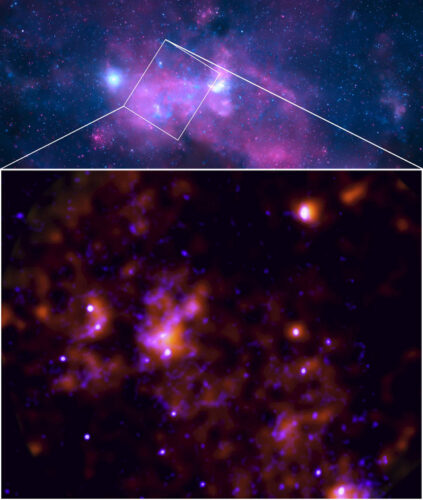
The area surrounding Sagittarius A* (Image IXPE: NASA/MSFC/F. Marin et al; Chandra: NASA/CXC/SAO; Image Processing: L.Frattare, J.Major & K.Arcand)

An article published in the journal “Nature” reports evidence that about 200 years ago, Sagittarius A*, or simply Sgr A*, the supermassive black hole at the center of the Milky Way, had a period of intense activity during which it swallowed considerable amounts of gas and dust. A team of researchers led by Frédéric Marin of the Astronomical Observatory of Strasbourg, France, used in particular data collected by the IXPE space telescope to examine the polarization of X-ray light emitted by bright large molecular clouds close to Sgr A*. The conclusion is that their out-of-normal brightness must have been due to the fact that they are reflected emissions produced by some kind of powerful and short-lived flare of the supermassive black hole that occurred about 200 years ago.

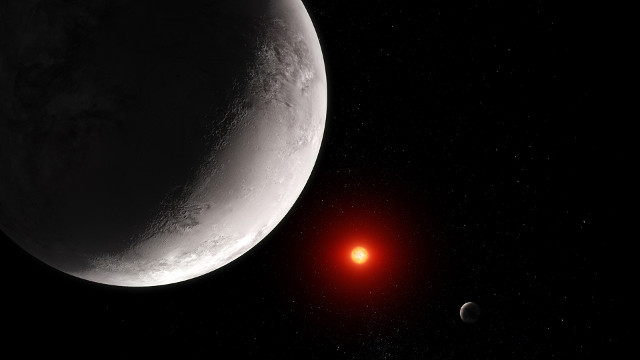
Artist's concept of the exoplanet TRAPPIST-1 c with its star in the background (Image NASA, ESA, CSA, Joseph Olmsted (STScI). Science: Sebastian Zieba (MPI-A), Laura Kreidberg (MPI-A))

An article published in the journal “Nature” reports a study on the exoplanet TRAPPIST-1 c which indicates that its atmosphere is very thin or non-existent. A team of researchers used the James Webb space telescope to examine one of the seven planets of the TRAPPIST-1 system and the results allow to rule out the hypothesis that it’s similar to Venus. Thermal emissions indicate a temperature on its surface’s day-side of about 107° Celsius. According to the researchers, this indicates that this exoplanet may have formed with little water.

An article published in the journal “Nature Astronomy” reports the discovery of a binary system that includes a white dwarf pulsar, the second such object discovered so far. A team of researchers that includes some of those who discovered the first white dwarf pulsar identified J191213.72-441045.1, or simply J1912-4410, a binary system that also includes a normal star belonging to the red dwarf class. This new discovery offers new insight into what constitutes a new class of cosmic objects with the potential to develop models to describe their formation and behavior.

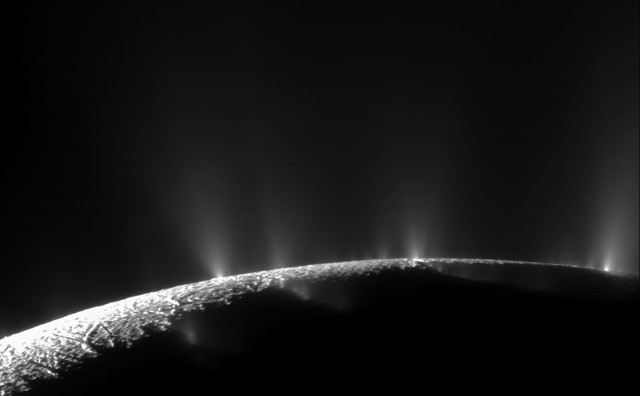
Enceladus and some of its geysers (Image NASA/JPL/Space Science Institute)

An article published in the journal “Nature” reports the discovery of phosphorus, a key element for many biological processes, on Enceladus, the moon of the planet Saturn which has an underground ocean of liquid water. A team of researchers led by Frank Postberg of the Freie Universität Berlin, Germany, analyzed data collected by the Cassini space probe made available in the Planetary Data System and in particular the data detected by the Cosmic Dust Analyzer instrument in samples of icy particles emitted by the geysers of Enceladus that arrived in one of Saturn’s rings.

The result of the analysis was the discovery of phosphates in concentrations at least one hundred times higher than those of the Earth’s oceans. Geochemical models suggest that phosphorus may be present in subsurface oceans of other moons. These discoveries increase the probability that life forms have arisen in the subsurface of some of those moons.

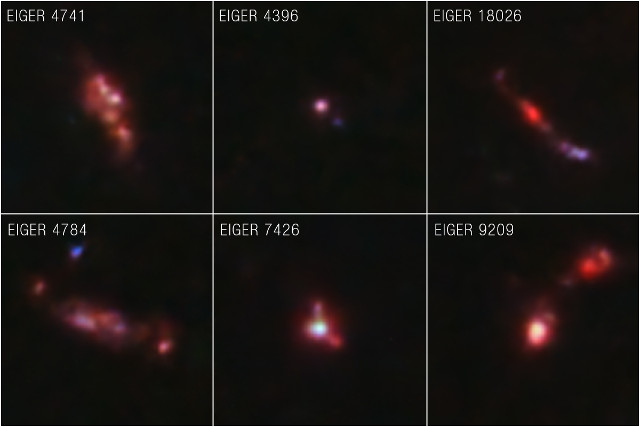
Some galaxies observed in this study, which we see as they were when the universe was 900 million years old

Three articles published in “The Astrophysical Journal” report various aspects of a study on the epoch of reionization and bring evidence that the first galaxies transformed the universe from an opaque place to the current place where light can spread. Researchers from the EIGER team led by Simon Lilly of the ETH Zurich, Switzerland, used the James Webb Space Telescope together with some ground-based telescopes to observe primordial galaxies finding transparent regions around them thanks to the reionization of the gas.