Astronomy / Astrophysics

The galaxy Arp 220 as seen by the James Webb Space Telescope

An image (NASA, ESA, CSA, STScI. Image processing: Alyssa Pagan (STScI)) captured by the James Webb Space Telescope portrays Arp 220, a galaxy that is the result, still not fully completed, of a galaxy merger. Intense processes are ongoing within this new galaxy as a consequence, starting with a remarkable star formation activity. X-ray emissions detected by other instruments suggest the presence of an active galactic nucleus. These are activities connected to its nature as an ultraluminous infrared galaxy (ULIRG) whose emissions allowed Webb to capture many new details.

The JUICE space probe blasting off atop an Ariane 5 ECA rocket (Image courtesy Arianespace)

A little while ago, ESA’s JUICE (JUpiter ICy moons Explorer) space probe was launched atop an Ariane 5 ECA rocket from the Kourou base in French Guiana. After about 27 minutes, it successfully separated from the rocket’s last stage and began the long journey that will take it to Jupiter orbit, where it will conduct its scientific mission, focused on the largest planet in the solar system’s so-called icy moons: Ganymede, Europa, and Callisto.

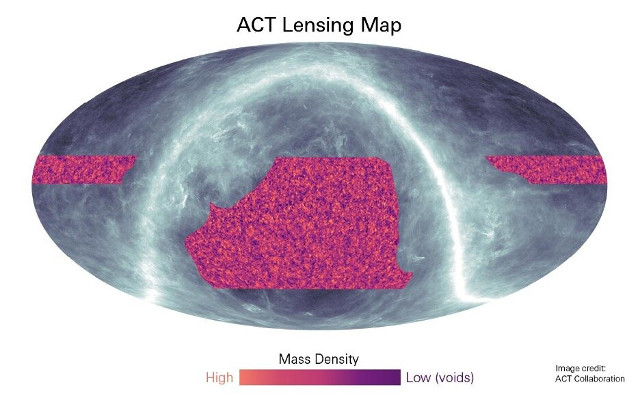
The map of dark matter based on observations from the Atacama Cosmology Telescope

During the Future Science with CMB x LSS conference underway at Kyoto University, Japan, the results of a detailed mapping of dark matter in a part of the universe were presented. Three articles available in preview and submitted to “The Astrophysical Journal” illustrate these results, obtained using observations conducted at the Atacama Cosmology Telescope (ACT) in Chile, which operated between 2007 and 2022. This map (Image courtesy ACT Collaboration) was obtained by analyzing the cosmic microwave background radiation and its deviations caused to the gravity of massive structures such as concentrations of dark matter.

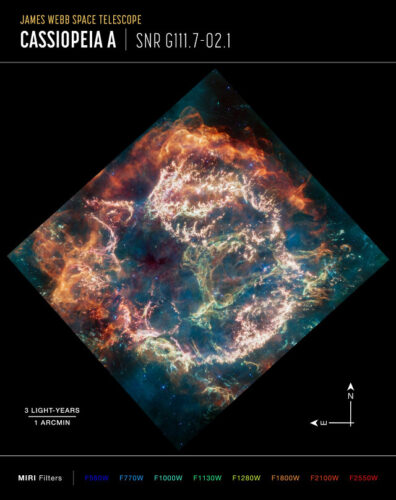
The Cassiopeia A supernova remnant as seen by the James Webb Space Telescope

An image of the supernova remnant cataloged as Cassiopeia A (NASA, ESA, CSA, D. Milisavljevic (Purdue University), T. Temim (Princeton University), I. De Looze (UGent), J. DePasquale (STScI)), or simply Cas A, captured by the James Webb Space Telescope shows never-before-seen details of the structures present within the materials surrounding what remains of the progenitor star. These are useful details for astronomers to reconstruct the processes that take place in the last stages of the life of a massive star and the consequences of a supernova. Elements generated by the star are scattered into space, including cosmic dust in quantities that could explain the abundance discovered in early galaxies.

The two quasars of SDSS J0749+2255 as seen by Hubble (Image NASA, ESA, Yu-Ching Chen (UIUC), Hsiang-Chih Hwang (IAS), Nadia Zakamska (JHU), Yue Shen (UIUC))

An article published in the journal “Nature” reports the discovery of a pair of merging galaxies cataloged as SDSS J0749+2255 which has the peculiarity of hosting a double quasar. A team of researchers led by the University of Illinois at Urbana-Champaign used various ground-based and space telescopes to study SDSS J0749+2255 to obtain observations detailed enough to resolve the two quasars, both of which are extremely bright. The difficulty in these observations is also given by the fact that this pair is very distant and we see it as it was when the universe was about three billion years old and the distance between the two supermassive black holes that power their respective quasars is only about ten thousand light-years.