Astronomy / Astrophysics

Artist's impression of a magnetar eruption. (Image NASA's Goddard Space Flight Center)

An article published in the journal “Nature Astronomy” reports an explanation for the abrupt slowdown in the rotation of the magnetar cataloged as SGR 1935+2154 and its attribution to a sort of volcano that ejected a kind of wind into space. A team of researchers used X-ray data from ESA’s XMM-Newton space telescope and NASA’s NICER instrument to analyze changes in the magnetar. Their conclusion is that the activity of the pseudo-volcano altered the magnetar’s magnetic field, slowing down its rotation, what in jargon is called anti-glitch. That led to the beginning of radio wave emissions subsequently detected by the Chinese FAST radio telescope.

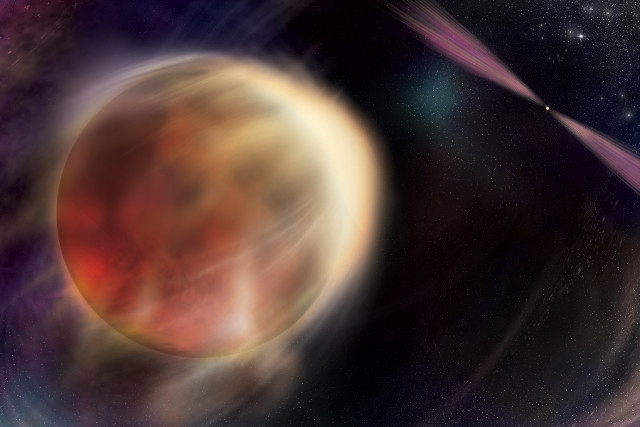
Artist's impression of a binary system containing a spider pulsar (Image NASA/Sonoma State University, Aurore Simonnet)

An article published in the journal “Nature Astronomy” reports the detection of gamma-ray eclipses in binary systems formed by a normal star or a brown dwarf that have a pulsar as a companion that is defined as a spider pulsar because they steal gas from the companion behaving like a black widow. A team of researchers used data collected over a decade by NASA’s Fermi Space Telescope to find cases in which the star passes in front of the pulsar. Seven binaries have been identified with a spider pulsar being eclipsed by its companion. This identification made it possible to measure the pulsar’s mass, a result useful to conduct tests on the theory of relativity and understand the behavior of matter in extreme conditions.

The occultation light curve of the background star caused by the passage of asteroid Chariklo captured by the James Webb Space Telescope's Near-infrared Camera (NIRCam) instrument

A stellar occultation that took place on October 18, 2022, made it possible to study asteroid Chariklo observing its rings as well, a truly peculiar feature for such a small object. A team of researchers used the James Webb Space Telescope to capture Chariklo’s passage in front of a star from Webb’s point of view. The NIRCam and NIRSpec instruments enabled images and spectrographic features of Chariklo to be obtained. In recent days, the NIRISS instrument had a software problem that blocked the transmission of the collected data but no hardware failures were found, therefore it’s possible that the data will be recovered later to complete an in-depth study of this asteroid.

A set of what are called super images that show Io's volcanic hot spots at different times when this moon was subject to observations

An article published in the journal “Geophysical Research Letters” reports the most accurate map created so far of the volcanoes of Io, one of the planet Jupiter’s Galilean moons. A team of researchers led by Francesca Zambon of the Italian National Institute of Astrophysics used data collected by the Juno space probe’s JIRAM instrument in a NASA mission that also sees the collaboration of the Italian Space Agency regarding JIRAM. The surveys made it possible to identify 242 volcanic hot spots, 23 of which had not been previously detected. The new hot spots were identified mainly in the polar regions, an achievement possible thanks to Juno’s orbit.

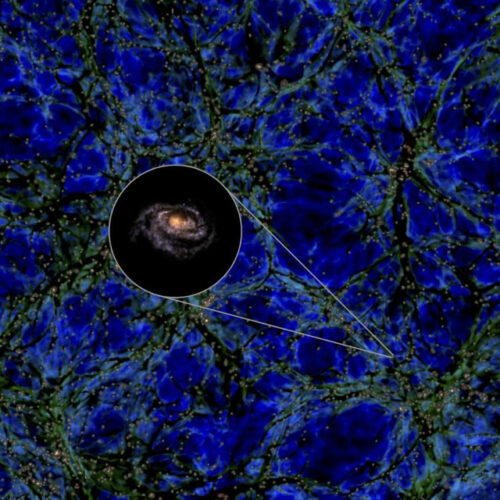
An image of the Milky Way superimposed on that of galaxies (represented as yellow dots) simulated in the IllustrisTNG project immersed in dark matter (in green and blue)

An article published in the journal “Monthly Notices of the Royal Astronomical Society” reports the results of a study that indicates that the Milky Way is abnormally massive in relation to the so-called Local Sheet, the group of galaxies that surround it. A team of researchers used simulations conducted within the IllustrisTNG project and discovered that a galaxy in the same situation as the Milky Way should be much smaller than the cosmic wall that surrounds it. The simulations indicate that there’s one exception for every million galaxies in IllustrisTNG under the same conditions. This must be kept in mind in studies of galactic environments.