Astronomy / Astrophysics

An article published in “The Astrophysical Journal Letters” reports a study on the exoplanet Kepler-1658b which predicts the decay of its orbit until it’s destroyed by its star. A team of researchers used data gathered from observations conducted over several years, from those by the Kepler Space Telescope that discovered Kepler-1658b to those by the TESS Space Telescope to examine its orbit. The conclusion is that this gas giant is slowly approaching its star and will be destroyed in the future.

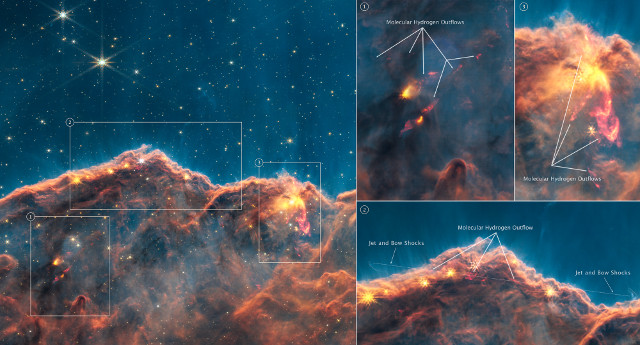
The Cosmic Cliffs and in the insets on the right side the details of some areas with indications of hydrogen outflows, jets, and bow shocks, the shock waves caused by that activity

An article published in the journal “Monthly Notices of the Royal Astronomical Society” reports a study of the open cluster NGC 3324, part of the Carina Nebula, one of the largest known star nurseries. A team of researchers used observations conducted with the James Webb Space Telescope to specifically study an area on the edge of NGC 3324 nicknamed the Cosmic Cliffs. The nickname is due to the jagged appearance like a cliff but instead of water and rocks, there’s an expanse of gas and dust. The amplitude of the infrared frequencies detected by Webb made it possible to obtain more details than ever of what is happening in the midst of those cosmic clouds, finding 24 new outflows of molecular hydrogen associated with as many protostars.

An artist's impression of the GJ 1002 system with its two planets

An article published in the journal “Astronomy & Astrophysics” reports the discovery of two exoplanets that are slightly larger than Earth in the GJ 1002 star system, almost 16 light-years away from Earth. A team of researchers used a combination of data collected by two spectrographs, ESPRESSO mounted on the VLT and CARMENES at the Calar Alto observatory, to study GJ 1002 and find the traces of two exoplanets around it. Both of them are within their system’s habitable zone where there could be conditions similar to those on Earth. The top image (Courtesy Alejandro Suárez Mascareño and Inés Bonet (IAC)) shows an artist’s impression of the GJ 1002 system with its two planets.

The galaxies RS13 and RS14 as they appeared in images captured by the Spitzer Space Telescope and as they appear in the image captured by Webb

An article published in “The Astrophysical Journal Letters” reports the identification of a population of rare red spiral galaxies in the SMACS J0723.3-7327 galaxy cluster. A team of researchers used observations conducted with the James Webb Space Telescope to find details of these galaxies which are estimated to date back to when the universe was about two to three billion years old.

The unprecedented detail captured by Webb helps to make progress in understanding the processes taking place in galaxies of various ages and understand why some appear red. Finding several very old ones suggests that over 10 billion years ago, red galaxies were more common.

Infographic of the primordial galaxies observed with the James Webb Space Telescope

Two articles that have yet to pass the peer-review phase report some results of observations of primordial galaxies conducted with the James Webb Space Telescope within the JWST Advanced Deep Extragalactic Survey (JADES) program which has precisely the aim of studying the oldest and faintest galaxies. A team of astronomers used Webb’s NIRCam and NIRSpec instruments to determine the distances of four galaxies we see as they were less than 400 million years after the Big Bang using a spectroscopic analysis of their light.