Astronomy / Astrophysics

The Tianwen-2 space probe blasting off atop a Long March 3B rocket (Photo courtesy Xinhua/Cai Yang)

A few hours ago, the Tianwen-2 mission was successfully launched. A Long March 3B rocket blasted off from the Xichang Satellite Launch Center, and after about 18 minutes, the space probe separated from the rocket’s last stage to begin its journey towards the asteroid 469219 Kamoʻoalewa. The goal is to collect samples from its surface to bring back to Earth and then resume its journey in space towards the comet 311P/PanSTARRS.

The Magellanic Clouds as seen by the Gaia space probe (Image ESA)

An article published in “The Astrophysical Journal Letters” reports the results of a study of the Small Magellanic Cloud that shows how this dwarf galaxy is undergoing distortions in its shape due to various gravitational influences. Satoya Nakano and Kengo Tachihara of Nagoya University, Japan, used data collected by ESA’s Gaia space probe together with information on Cepheid stars collected by the OGLE (Optical Gravitational Lensing Experiment) project. This allowed them to determine the distances of 4,236 Cepheids and the anomalies in their motions. The conclusion is that the Small Magellanic Cloud is undergoing a gravitational influence from the Large Magellanic Cloud and another as yet unknown source.

On the left the supernova SN 1987A remnant as seen by the James Webb Space Telescope, and in the other two panels the simulation of the density distribution of the remnant, which include the iron-rich materials, and the current morphology of that remnant

An article to be published in the journal “Astronomy & Astrophysics” reports a study of the supernova SN 1987A that offers evidence that the explosion was decidedly asymmetric and dominated by two bipolar jets. A team of researchers led by astrophysicist Salvatore Orlando of the Italian National Institute of Astrophysics in Palermo has developed a model that takes into account the interaction between matter and magnetic field to study the evolution of SN 1987A. The results successfully reproduce the morphology of the iron-rich ejected materials, which was observed in particular by the James Webb Space Telescope. This shows that those structures are the result of an asymmetric explosion.

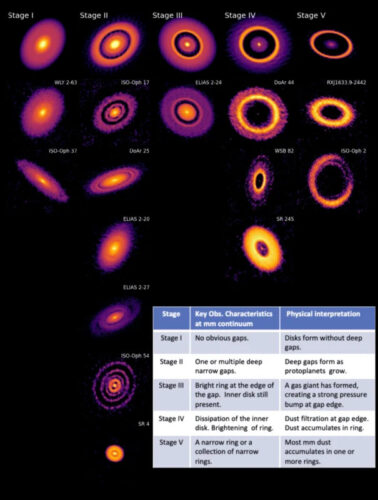
15 protoplanetary disks studied in the ODISEA project with their classification according to the proposed model

An article published in “The Astrophysical Journal Letters” reports a model that traces the evolution of protoplanetary disks through five stages. A team of researchers from the ODISEA (Ophiuchus DIsc Survey Employing ALMA) project developed this model using both simulations and observations of protoplanetary disks within the Ophiuchus molecular cloud obtained using the ALMA radio telescope. The type of evolution observed confirms the division into stages proposed in 2020 in an article published in the journal “Monthly Notices of the Royal Astronomical Society” and offers some confirmation of the mechanisms by which giant planets influence the dynamics within those disks.

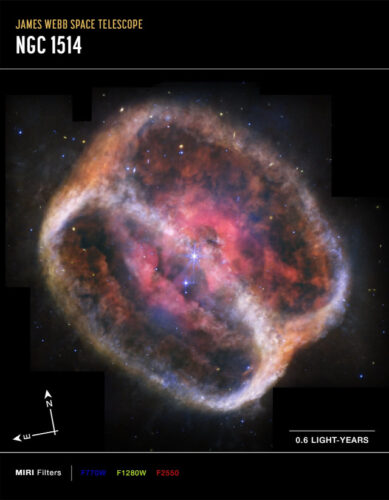
Planetary Nebula NGC 1514 (MIRI image, annotated)

An image captured by the James Webb Space Telescope depicts NGC 1514, a planetary nebula with a dying star at its center. The MIRI (Mid-Infrared Instrument) captured details never seen before, especially of the rings visible only in infrared. The dying star has a companion, although in the images, it seems that thre’s a single bright star at the center of the nebula. This show will continue for many more millennia before the materials disperse into interstellar space. In the meantime, the dying star already only has a compact core left in the form of a white dwarf.