Astronomy / Astrophysics

Jupiter seen through three filters applied to the James Webb Space Telescope's NIRCam (Near-Infrared Camera) instrument

NASA has published some photos of Jupiter captured by the James Webb Space Telescope that offer new information on the processes taking place within the largest planet in the solar system. The combination of different infrared filters leads to various results that allow appreciating new details of Jupiter. The colors are different from the real ones precisely because Webb detected them using infrared filters but the results are very interesting for the information they offer on storms, auroras, and various processes taking place on the planet and within it. Some images also include its rings and some of its moons.

At the center the stars R136a1, R136a2 and R136a3 seen by the Zorro instrument in visible light

An article accepted for publication in “The Astrophysical Journal” reports a study on the star R136a1, perhaps the most massive known. A team of researchers pushed the Zorro instrument mounted on the Gemini South telescope to its limits to observe R136a1, or RMC 136a1. The results suggest that it’s less massive than previously estimated, as it was thought to be even more than 300 times the Sun’s mass. It remains a colossus given that the new estimate peaks in probability at 196 times the Sun’s mass. Two “siblings” may also be less massive than previously estimated, as this study estimates the mass of the star R136a2 to be about 151 times the Sun’s and the mass of the star R136a3 to about 155 times the Sun’s. Understanding these huge stars better helps to better predict their end and the chemical elements that will be created at that stage.

Artist's concept of a Neptune-sized planet orbiting a class-A star (Image courtesy Steven Giacalone, UC Berkeley)

An article published in “The Astrophysical Journal Letters” reports a study on the exoplanet HD 56414 b, a warm Neptune discovered orbiting an A-type star that has a mass almost twice the Sun’s. A team of researchers used detections conducted by NASA’s TESS space telescope to find a candidate exoplanet that was subsequently verified thanks to follow-up observations conducted with other instruments. This is a rare combination, as these massive stars usually have giant planets like Jupiter or even more massive ones.

Phases of the Great Dimming of Betelgeuse

An article accepted for publication in “The Astrophysical Journal” reports an analysis of the situation of the star Betelgeuse examining its recovery after what was called the Great Dimming. A team of researchers used a number of instruments including the Hubble Space Telescope and other ground-based and space observatories to reconstruct the history of that event and to examine its consequences. Betelgeuse is returning to what it was a few years ago but not exactly because the colossal coronal mass ejection, confirmed once again by this study, which caused the Great Dimming has also altered stellar cycles that had existed for at least two centuries.

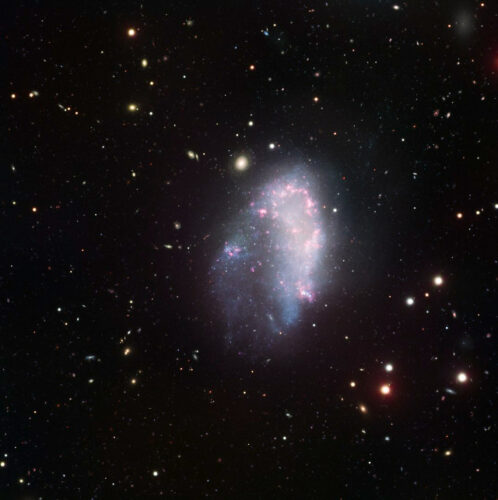
NGC 1427A, one of the dwarf galaxies in the Fornax cluster that appear to be devoid of dark matter halos (Image ESO)

An article published in the journal “Monthly Notices of the Royal Astronomical Society” reports the results of a study of the distribution and morphology of the dwarf galaxies of the Fornax cluster which concludes that they are free of dark matter halos. A team of researchers coordinated by the German University of Bonn and the Scottish University of Saint Andrews examined those dwarf galaxies to see how perturbed they are by gravitational tides generated by nearby galaxies.