Astronomy / Astrophysics

The galaxy CGCG 396-2 (Image ESA/Hubble & NASA, W. Keel)

An image captured by the Hubble Space Telescope shows the galaxy CGCG 396-2, out of the ordinary thanks to its many arms. It’s a galaxy that has become an object of interest by the Galaxy Zoo project, one of the astronomical projects that involve the public, in this case, to classify galaxies observed by various telescopes. CGCG 396-2 was selected for follow-up observations with Hubble, whose ACS instrument made it possible to examine the arms that have an unusual configuration because there’s a galaxy merger taking place and consequently an unusual shape that is changing over time.

The ultra-faint dwarf galaxy Pegasus V

An article submitted for publication in the journal “Monthly Notices of the Royal Astronomical Society” reports the identification of an ultra-faint dwarf galaxy that was named Pegasus V near the Andromeda galaxy. A team of researchers conducted follow-up observations following the discovery made by an amateur astronomer and, using the GMOS instrument mounted on the Gemini North telescope in Hawaii, confirmed its existence. An interesting result of the observations is the very limited presence of elements heavier than hydrogen and helium, a discovery that led to the conclusion that it’s a kind of fossil of a primordial galaxy.

A comparison between the Earth and the exoplanet TOI-1807 b (Image Nardiello/NASA – Eyes-on-exoplanets)

An article published in the journal “Astronomy & Astrophysics” reports a study of the exoplanet TOI-1807 b, a rocky planet discovered in 2020 thanks to NASA’s TESS space telescope. A team of researchers led by the Italian National Institute of Astrophysics and the University of Padua used the HARPS-N spectrograph installed on the Galileo National Telescope in the Canary Islands to conduct follow-up examinations of TOI-1807 b. The conclusion is that it’s a slightly larger exoplanet than Earth but the main peculiarity is that it’s the youngest of the type with an ultra-short period orbit, as it’s estimated to be around 300 million years old and its year lasts about 13 hours.

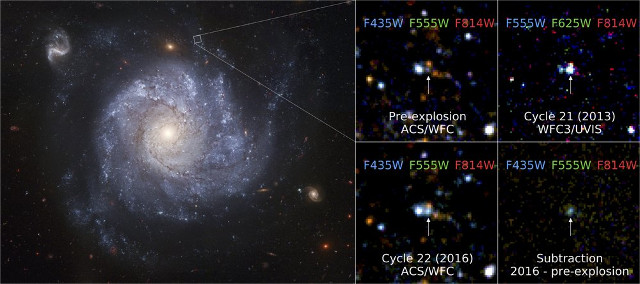
On the left the galaxy NGC 1309 and on the right images of the area where the supernova SN 2012Z occurred, captured over the years

An article published in “The Astrophysical Journal” reports a study of the consequences of the supernova cataloged as SN 2012Z, considered to be of the type Iax, which means that it’s the explosion of a white dwarf. A team of researchers used the Hubble Space Telescope to study its remnants and found that the star survived the supernova and is even brighter than before. One possibility is that the explosion was too weak to scatter the remnants of the white dwarf into interstellar space with the result that they started re-aggregating.

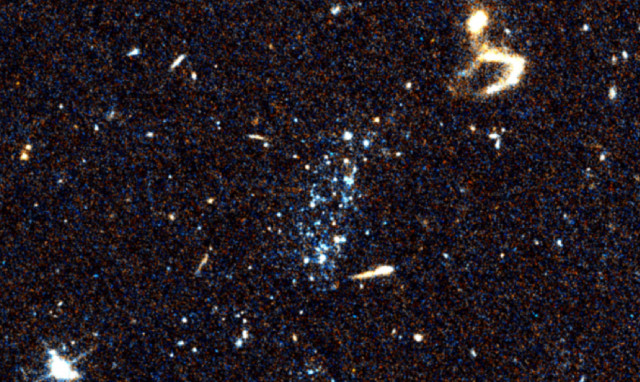
One of the star systems discovered in the Virgo cluster seen by the Hubble Space Telescope (Image courtesy Michael Jones)

An article submitted for publication to “The Astrophysical Journal” reports the discovery of star systems that are even smaller than a dwarf galaxy and are isolated from any normal galaxy. A team of researchers examined a catalog of gas clouds found in a previous survey looking for new galaxies and found small clusters that contain mostly young blue stars scattered irregularly within the Virgo galaxy cluster. These are cases similar to the one cataloged as SECCO 1, another system discovered in the Virgo cluster and reported in an article published in February 2018 in the journal “Monthly Notices of the Royal Astronomical Society”. The discovery of other such groups may help to understand their origin.