Astronomy / Astrophysics

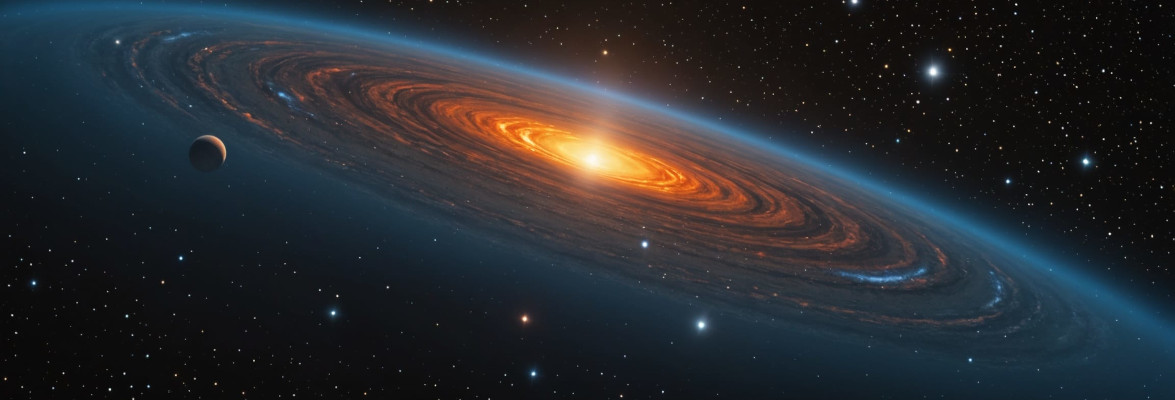
Artist’s Illustration of Exoplanets Orbiting Barnard’s Star (Image International Gemini Observatory/NOIRLab/NSF/AURA/P. Marenfeld)

An article published in “The Astrophysical Journal Letters” reports confirmation of the existence of four exoplanets that are smaller than Earth orbiting Barnard’s Star. A team of researchers combined detections obtained with the MAROON-X instrument mounted on the Gemini North telescope in Hawaii with others obtained independently with the ESPRESSO instrument installed on ESO’s VLT in Chile. The result is the confirmation of the exoplanet Barnard b, whose existence was announced in October 2024, and three other sub-Earths, small planets that are almost certainly rocky.

The SPHEREx space telescope and the PUNCH satellites blasting off atop a Falcon 9 rocket (Image courtesy SpaceX)

A few hours ago, the SPHEREx space telescope and the PUNCH satellites, two NASA astronomy missions, blasted off atop a SpaceX Falcon 9 rocket from the Vandenberg base. After about 42 minutes, SPHEREx successfully separated from the rocket’s last stage, and about 10 minutes later, the PUNCH satellites also separated, within about a minute. Both missions will operate from a Sun-synchronous orbit at an altitude of 700 kilometers for SPHEREx and 570 kilometers for PUNCH.

Artist’s concept of SIMP 0136 (Image NASA, ESA, CSA, J. Olmsted (STScI))

An article published in “The Astrophysical Journal Letters” reports the results of a study of the super-Jupiter object cataloged as SIMP J013656.5+093347.3 and referred to as SIMP J0136+09 or simply SIMP 0136. A team of researchers used observations conducted with the James Webb Space Telescope to monitor the infrared emissions from this object. Its nature is still undetermined because it has an estimated mass of around 13 times Jupiter’s, at the boundary between a planet and a brown dwarf. The result is the discovery of an atmosphere that varies quickly, probably due to layers of clouds with different chemical compositions.

The Small Magellanic Cloud and the molecular coulds subject of this study

An article published in “The Astrophysical Journal” reports a study of 17 molecular clouds in the Small Magellanic Cloud, one of the Milky Way’s satellite dwarf galaxies. A team of researchers led by Kazuki Tokuda, a postdoctoral researcher at Kyushu University, Japan, examined high-resolution images captured using the ALMA radio telescope to obtain information on their characteristics. The examination showed that 40% of those clouds had a more diffused gas, with fluffy structures. The others were classic molecular clouds with a filamentary structure that are also found in the Milky Way. This difference was attributed to the scarcity of elements heavier than hydrogen and helium in the Small Magellanic Cloud, a situation similar to that of the early universe.

Mosaic of candidate active galactic nuclei in dwarf galaxie

An article to be published in “The Astrophysical Journal” reports the discovery of about 2,500 new candidate active galactic nuclei in dwarf galaxies and about 300 new candidate intermediate-mass black holes. A team of researchers examined observations conducted with the Dark Energy Spectroscopic Instrument (DESI) on the Nicholas U. Mayall 4-meter Telescope in Arizona to find all these possible black holes.