Astronomy / Astrophysics

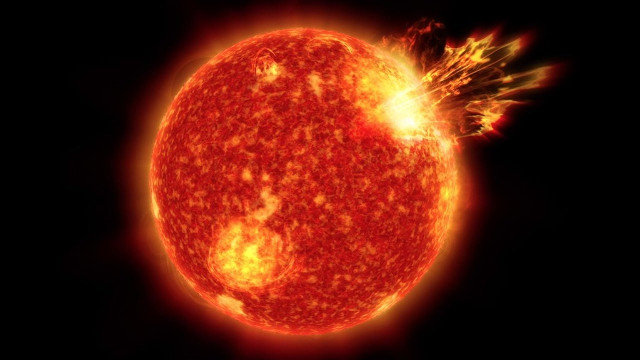
Artist's concept of what the Sun looked like 4 billion years ago (Image NASA's Goddard Space Flight Center/Conceptual Image Lab)

An article published in “The Astrophysical Journal” reports a study on the star Kappa 1 Ceti, very similar to the Sun in size and mass but much younger having an estimated age between 600 and 750 million years. A team of researchers coordinated by NASA’s Goddard Space Flight Center predicted some hard-to-measure features of Kappa 1 Ceti using computer models based on data collected by various NASA and ESA space telescopes. The results help to understand what the Sun looked like nearly four billion years ago, when it could emit superflares, to reconstruct the influence of its activity on early Earth and early life.

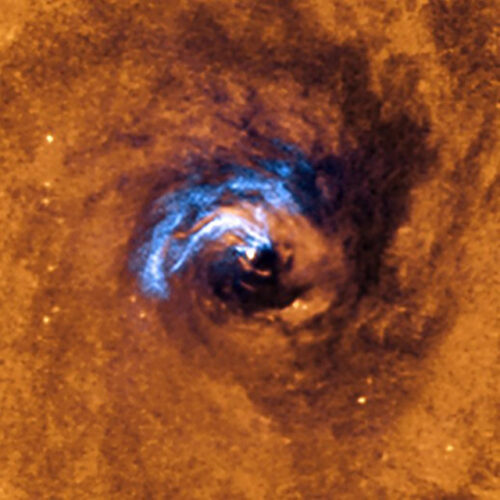
The process that was called nuclear feeding of the galaxy NGC 1566's supermassive black hole

An article published in the journal “Monthly Notices of the Royal Astronomical Society” reports a study on the feeding process of the supermassive black hole at the center of the galaxy NGC 1566. A team of researchers led by Almudena Prieto of the Instituto de Astrofísica de Canarias (IAC) used observations conducted with the Hubble Space Telescope, the VLT, and the ALMA radio telescope in Chile to be able to visualize filaments of interstellar dust that separate and subsequently head towards the supermassive black hole, approaching it in a spiral trajectory that eventually leads them to be swallowed. Those filaments could obscure the center of many galaxies with active galactic nuclei.

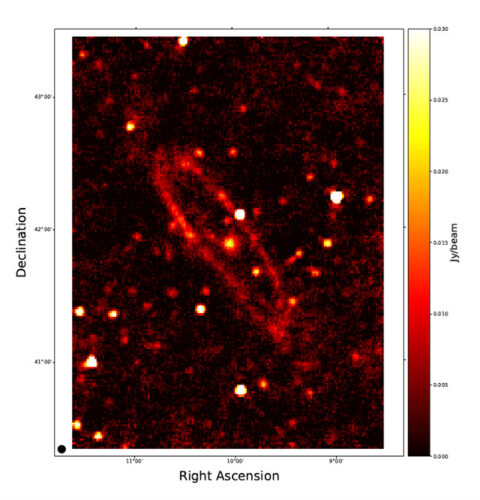
Andromeda seen from the Sardinia Radio Telescope

An article published in the journal “Astronomy & Astrophysics” reports a study on the Andromeda galaxy based on the best image captured in the microwave band. A team of researchers coordinated by Professor Elia Battistelli of the physics department at Sapienza used the Sardinia Radio Telescope (SRT) and its ability to work at high radio frequencies to create a map of Andromeda at 6.6 GHz, a frequency detected for the first time that fills a gap in the studies of the galaxy considered a sort of sister of the Milky Way. This helped to better understand the processes taking place within Andromeda identifying areas of star formation.

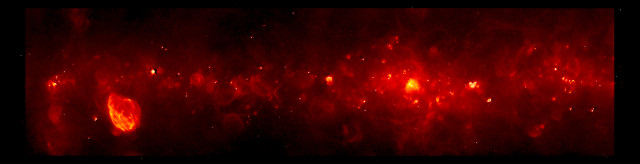
A map obtained from the GLOSTAR survey with a segment of the Milky Way disk

Four articles published in the journal “Astronomy & Astrophysics” report various aspects of the mapping of the northern galactic plane, which led, among other things, to the discovery of new areas of star formation in the Milky Way. Many researchers collaborated in the analysis of data collected within the GLOSTAR survey, which aims to examine star-forming regions within the galaxy using observations from the VLA and Effelsberg radio telescopes. The data made it possible to obtain the most detailed maps of the northern galactic plane at radio frequencies, which made it possible to identify the new star nurseries.

The PDS 70 system with the zoom on the protoplanet PDS 70 c

An article published in “The Astrophysical Journal Letters” reports a study on the circumplanetary disk around the exoplanet PDS 70 c. A team of researchers led by Myriam Benisty used the ALMA radio telescope to study what is still a protoplanet and the disk of materials around it that could form moons. According to estimates, there’s enough mass to form up to three moons the size of the Earth’s Moon. This type of study offers new information both on the formation of planets, especially gas giants, and on moons, one of the frontiers astronomers are trying to open.