Astronomy / Astrophysics

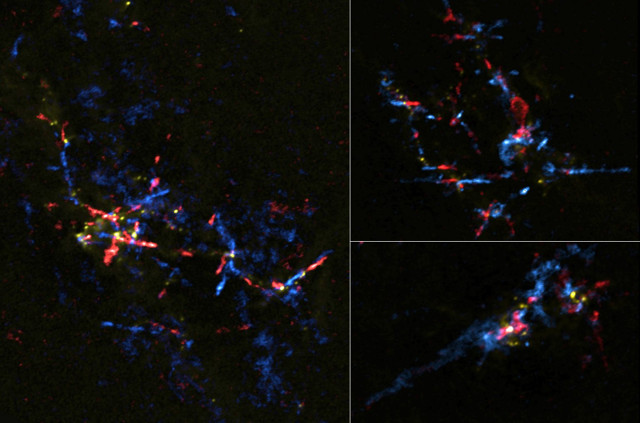
Some outflows indicating an origin from protostars

An article published in “The Astrophysical Journal” reports the discovery of four massive molecular clouds in the central area of ​​the Milky Way with traces of star formation in an area that was considered too chaotic for that to happen. A team of researchers used the ALMA radio telescope to examine the so-called Milky Way’s Central Molecular Zone (CMZ), discovering over 800 of what are considered stellar eggs, meaning dense cores of gas and dust. ALMA made it possible to detect 43 energetic outflows of materials with characteristics associated with star formation, further evidence of what’s happening in that area.

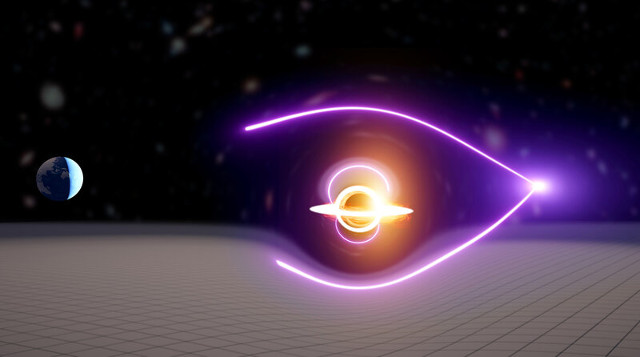
Artistic concept of the candidate intermediate-mass black hole and its deflected gamma-ray burst (Image courtesy Carl Knox, OzGrav)

An article published in the journal “Nature Astronomy” reports the discovery of a candidate intermediate-mass black hole. A team of researchers studied a gravitational lens using detections of photons that were part of a gamma-ray burst to calculate the mass of the lens based on the delay caused by the deviation of the photons of its “echo”. The result is that the mass of the object acting as a gravitational lens was estimated to be about 55,000 times the Sun’s. The nature of the object is not certain but the analysis of the data clearly favors the hypothesis that it’s an intermediate-mass black hole, a type of black hole that is rare and, above all, very elusive.

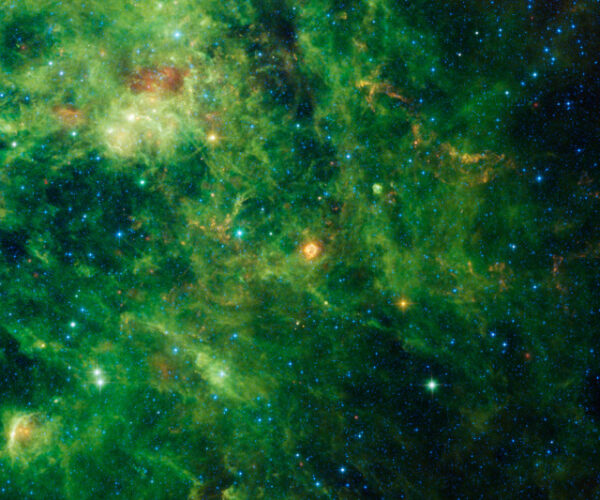
The supernova remnants Cassiopeia A (Image NASA/JPL-Caltech/UCLA)

NASA has released an image of the supernova remnants Cassiopeia A, or simply Cas A, captured by the WISE space telescope at infrareds. There’s no historical record of that supernova even though its light reached Earth around 1667 A.D., probably because a large amount of dust between it and the Earth greatly dimmed its brightness. Its various emissions made it possible to study it with different instruments over the last few decades. WISE detected the echoes of the light burst that are generating ripples outwards from the star that exploded.

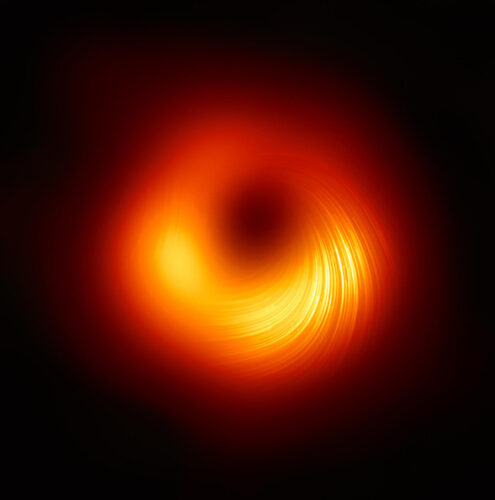
The area around the supermassive black hole of the galaxy M87 in polarized light

Two articles published in “The Astrophysical Journal Letters” report different aspects of a study that led to the representation of the area around the supermassive black hole at the center of the galaxy M87 in polarized light. Scientists from the Event Horizon Telescope Collaboration used data collected in 2017 to obtain a new image that offers new information on the structure of the magnetic fields around the supermassive black hole. A third article published in the same journal reports the details of the observations conducted with the ALMA radio telescope during the 2017 observation campaign.

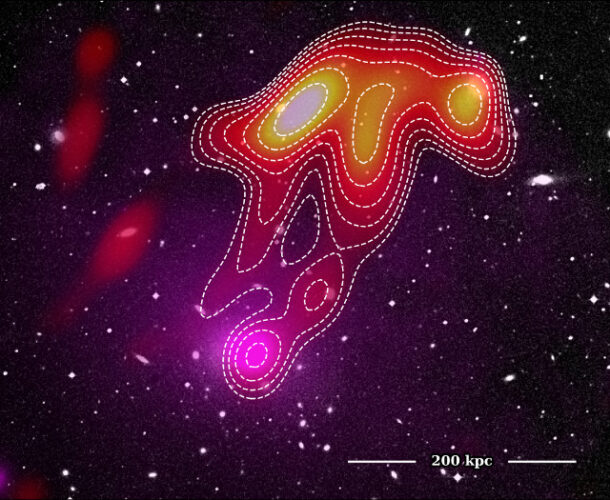
The cosmic jellyfish in the galaxy cluster Abell 2877

An article published in “The Astrophysical Journal” reports a study on the galaxy cluster Abell 2877 conducted with the MWA radio telescope which identified a plasma cloud with a shape similar to a jellyfish. A team led by Torrance Hodgson of the International Center for Radio Astronomy Research (ICRAR) observed Abell 2877 at different radio frequencies and, when they turned the frequency down, they discovered that cosmic structure visible for a short time and only at very few frequencies. It could be plasma ejected about two billion years ago from supermassive black holes in different galaxies that mixed just as shockwaves passed through the cluster, reigniting the plasma for a period that is very short from an astronomical point of view.