Space Probes

The Lucy space probe blasting off atop an Atlas V 401 rocket (Image NASA TV)

A little while ago NASA’s Lucy mission blasted off atop an Atlas V 401 rocket from Cape Canaveral. Almost 58 minutes after launch, the space probe separated regularly from the rocket’s last stage and entered the trajectory that is programmed to lead it towards Jupiter’s orbit, where there are the so-called Jupiter’s Trojan asteroids. There, Lucy will begin a series of flybys on a mission that is expected to last approximately 12 years.

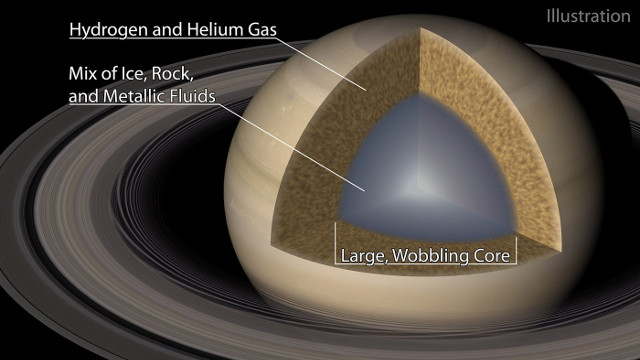
The possible structure of Saturn (Image courtesy Caltech/R. Hurt (IPAC))

An article published in the journal “Nature Astronomy” reports a study on the planet Saturn’s core. Caltech astronomers Christopher Mankovich and Jim Fuller analyzed data collected by the Cassini space probe on the oscillations of Saturn’s rings caused by the internal seismic activity to indirectly analyze the characteristics of the planet’s interior. The conclusion is that the core is not rocky but a mixture that has been compared to a soup or a sludge composed of ice, rock, and metallic fluids that fill a volume for about 60% of Saturn’s diameter, far more than it was previously estimated.

Scheme of Jupiter's X-ray auroras

An article published in the journal “Science” reports a study on the planet Jupiter’s auroras that offers a solution to the mystery of X-ray emissions. A team of researchers obtained the crucial information thanks to data collected by ESA’s XMM-Newton space telescope and NASA’s Juno space probe. That allowed them to understand how ions are transported by the electromagnetic waves present in the Jovian magnetic field to the planet’s atmosphere, with which they collide to generate the auroras.

Occator Crater on the dwarf planet Ceres and the structure of the ammonium molecule (Image NASA/JPL-Caltech/UCLA/MPS/DLR/IDA)

An article published in the journal “Nature Communications” reports a study of the origin of the ammoniated phyllosilicates present on the dwarf planet Ceres. A team of researchers conducted lab experiments based on the simulation of the Ceres environment. The results confirm the hypothesis that this dwarf planet formed in an area of ​​the solar system where ammonia ice is stable. However, they can’t rule out that it formed in the asteroid belt.

A NASA diagram of the PWS instrument's location and the antenna in common with the PRA instrument

An article published in the journal “Nature Astronomy” reports a study on the faint interstellar plasma waves detected by NASA’s Voyager 1 space probe. A team of researchers led by Stella Koch Ocker of Cornell University used a series of detections conducted by Voyager 1 while traveling a total distance that is about ten times the average distance of the Earth from the Sun which gives an idea of ​​the characteristics of the interstellar plasma when it’s not altered by events related to solar activity.