Space Probes

The OSIRIS-REx space probe being prepared (Photo NASA/Dimitri Gerondidakis)

NASA has confirmed that its OSIRIS-REx space probe has left the asteroid Bennu after more than two years of study. In fact, OSIRIS-REx reached Bennu on December 3, 2018. In addition to the data collected with its instruments, OSIRIS-REx will bring back to Earth a capsule containing the Bennu samples collected on October 20, 2020. The return journey will be long because the arrival is scheduled for September 24, 2023.

The 12 Einstein crosses

An article accepted for publication in “The Astrophysical Journal” reports the identification of 12 quasars whose image has been quadrupled by gravitational lenses obtaining images similar to the so-called Einstein Cross. Researchers from the Gaia Gravitational Lenses (GraL) group used data collected by ESA’s Gaia space probe and NASA’s WISE space telescope and examined them with machine learning algorithms. In this way, it was possible to recognize quasar candidates whose image was distorted by gravitational lenses leading to the identification of 12 Einstein crosses.

Mars dust storm (Image ESA/DLR/FU Berlin, CC BY-SA 3.0 IGO)

An article published in the “Journal of Geophysical Research: Planets” and one published in the journal “Icarus” report two studies that offer new information on the processes of water loss on the planet Mars. Two teams of researchers led respectively by Anna Fedorova of the Russian Academy of Sciences and Jean-Yves Chaufray of the French Laboratoire Atmospheres Observations Spatiales mainly used observations conducted with ESA’s Mars Express space probe’s SPICAM instrument together with data collected from other space probes to study the Martian atmosphere. The conclusion is that seasonal cycles and dust storms are the main causes of the dispersion of water in space. However, some of the water on Mars may still be present in the subsoil as well as in the polar ice caps.

Mars seen by Tianwen 1 (Photo courtesy CNSA/CASC)

Yesterday, the Tianwen 1 mission reached the planet Mars, and the spacecraft which includes a space probe, a lander, and a rover entered its orbit correctly. Launched on July 23, 2020, it’s an ambitious mission for China with plans to explore Mars in various ways after successfully starting various missions to the Moon. The main spacecraft engined burned for about 15 minutes to perform the braking maneuver needed to enter an orbit that will reach up to 400 kilometers of altitude. The landing timeline and location in the Utopia Planitia region of the lander and rover will be decided later for a phase of the mission that could take place in May or June.

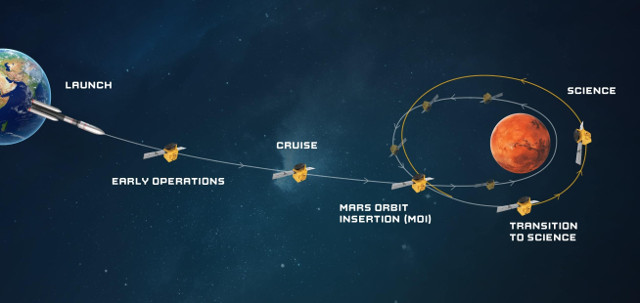
Infographic of the Hope space probe's journey

Yesterday, the Arab space probe Hope, or Al Amal, correctly entered the planet Mars orbit. Launched on July 20, 2020, Hope kept its six engines burning for 27 minutes to slow down to the speed needed to enter orbit, an automated maneuver that required absolute precision to prevent the spacecraft from going over Mars or crashing to the Martian surface. The lights of the tallest skyscraper in the world, the Burj Khalifa in Dubai, were switched on to celebrate the success of the first Arab mission.