
Space Probes

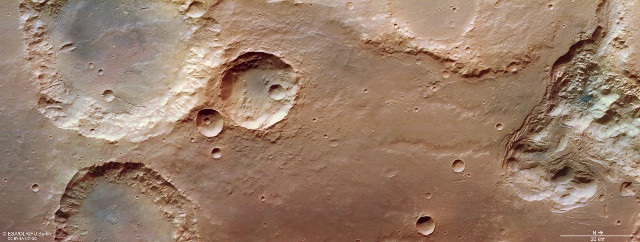
Chaotic terrain in Mars Pyrrhae Regio seen by Mars Express

ESA has released new images captured by its Mars Express space probe’s High Resolution Stereo Camera (HRSC) in Pyrrhae Regio, a region close to the Valles Marineris system on planet Mars. This is what is called chaotic terrain of the kind that forms when there’s underground ice that melts causing large amounts of water to be released. Such a process requires a significant amount of heat, which may have been provided by volcanic activity or a meteor impact. The current look is what is left after the water drained away, leaving in particular the geological formations called mesas.

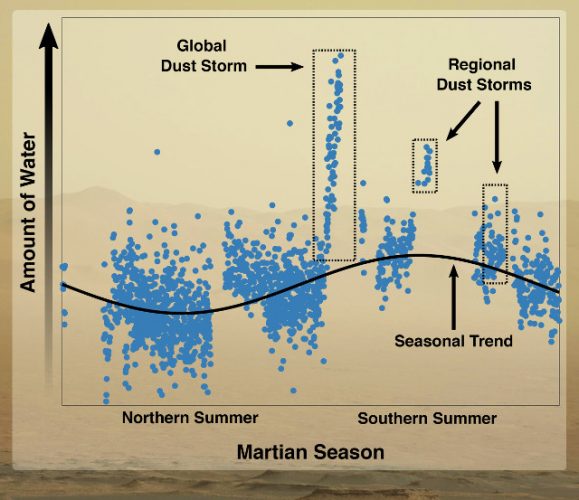
A depiction of water in Mars' atmosphere with peaks during periods of both regional and global dust storms

An article published in the journal “Science” reports a study that explains where most of the water that the planet Mars possessed when it was young, when it was in the liquid state on its surface, has gone. A team of researchers led by Shane Stone of the University of Arizona, USA, used data collected by NASA’s MAVEN space probe to track the movements of water in the atmosphere, up to high altitudes, where there are reactions that break it down and produce atomic hydrogen that is dispersed in space. This study highlighted the role of dust storms in water loss.

The crater triplet in Noachis Terra (Image ESA/DLR/FU Berlin, CC BY-SA 3.0 IGO)

ESA has published photos taken by its Mars Express space probe’s High Resolution Stereo Camera (HRSC) of a crater triplet in the Noachis Terra region on planet Mars. That region gave its name to the Noachian era in which, between about 3.7 and 4.1 billion years ago, the red planet was hit by a particularly large number of meteorites, and Noachis Terra is full of craters still existing. A crater triplet with an overlap indicating three very close impacts is interesting not only as a curiosity but also for the geological history it can tell together with others from the same region.

The points of the various landings made by the lander Philae on the surface of comet 67P/Churyumov-Gerasimenko

An article published in the journal “Nature” reports a reconstruction of the trajectory of ESA’s Rosetta mission’s Philae lander in its touchdown on the surface of comet 67P/Churyumov-Gerasimenko. A team of researchers examined data collected by the Rosetta space probe and the Philae lander to find out where the latter made its second touchdown on the comet, which was followed by further bounces before finally landing. The study also showed that the affected materials contained an abundant amount of ice as soft as freshly laid snow, to the point of being described as softer than cappuccino froth.

The TAGSAM mechanism's head

NASA has announced that the first visual inspection of the OSIRIS-REx space probe’s TAGSAM system, which captured soil samples from asteroid Bennu in the night between 21 and 22 October, has done its job well. In fact, the problem appears to be that the mechanism captured far too many materials and, after OSIRIS-REx moved away from Bennu, they started escaping. For this reason, the mission team decided to skip the various operations that would have allowed more significant examinations of the samples to try to seal them in the Sample Return Capsule to bring them back to Earth.