Space Probes

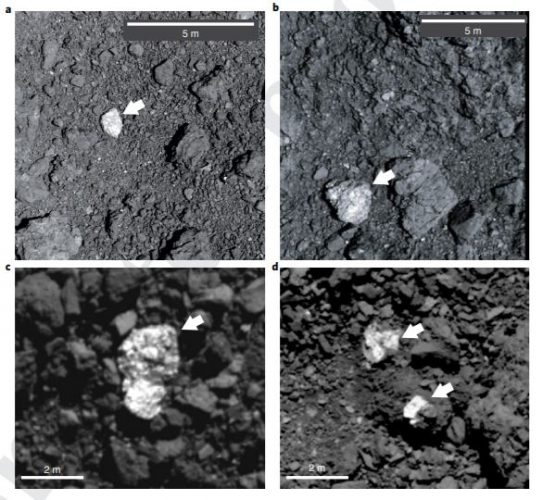
Bright boulders on asteroids Ryugu and Bennu

Three articles published in the journal “Nature Astronomy” report the results of as many researches on asteroids Ryugu and Bennu, which are being explored respectively by JAXA’s Hayabusa 2 and NASA’s OSIRIS-REx space probes. The two asteroids already showed some similarities and, in a news & views editorial, Maria Cristina De Sanctis talks about the catastrophic events that might have generated them and the bright rocks discovered on the surface of both despite their dark color. Catastrophic events are also the object of the other two articles, and in the one focused on Bennu, there are indications that some rocks on its surface come from Vesta, one of the largest objects in the asteroid belt between Mars and Jupiter.

Views of Enceladus

An article published in the journal “Icarus” reports a study on the frozen crust on the surface of Enceladus, the moon of Saturn which has an ocean of liquid water under its crust. A team of researchers analyzed data collected by the Cassini space probe’s Visible and Infrared Mapping Spectrometer (VIMS) instrument to obtain the most detailed infrared map of Enceladus’s surface. The map shows a clear correlation between reflected infrared emissions and geological activity, and in some areas, the surface ice turns out to be recent.

The environment around asteroid Bennu shortly after the ejection occurred on August 28, 2019

A special collection of articles published in “Journal of Geophysical Research: Planets” reports the results of various researches on asteroid Bennu, in some cases already published in recent months. Various researchers used data collected by NASA’s OSIRIS-REx space probe getting some surprises about what happens on Bennu such as the loss of materials being ejected into space. Possible causes include meteoroids, thermal stress, and the ricochet of particles that fall back to the surface then bounce back into space. Bennu’s activity could only be noticed by a nearby space probe, and this raises the question of the possible activity of other asteroids.

Scheme of the CONSERT radar's work

An article published in the journal “Monthly Notices of the Royal Astronomical Society” reports a study indicating that the interior of the nucleus of comet 67P/Churyumov-Gerasimenko is porous and less dense than its surface. A team of researchers reviewed data collected by ESA’s Rosetta space probe and its Philae lander’s CONSERT instrument. The signals exchanged between them through the cometary nucleus propagated at different speeds, indicating a varying density of its interior. This suggests that solar radiation changed the surface, making it less porous.

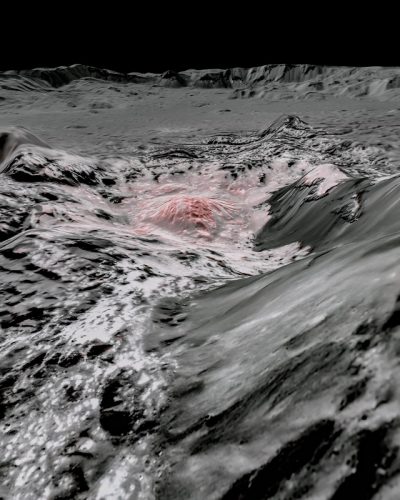
Cerealia Facula in Occator Crater

The Nature group has dedicated a special issue to the dwarf planet Ceres with a series of articles published in its journals. Various teams of researchers studied different aspects of the geology of Ceres with particular attention to the presence of water and hydrated sodium chloride, in very simple words table salt mixed with water. There are confirmations of the presence in the past of an underground ocean of which a strong presence of salts significantly lowered the freezing point. The salts present in the famous bright spots such as that in Occator Crater are among the remains of that ocean: they’re mainly sodium carbonate and ammonium chloride, but there’s also sodium chloride.