Space Probes

Proxima Centauri seen from Earth and the New Horizons space probe

NASA has released images obtained by its New Horizons space probe during the interstellar parallax experiment conducted on April 22 / 23, 2020. The LORRI camera was aimed at Proxima Centauri and Wolf 359, two of the stars closest to the system solar, obtaining images that show how they appear in different positions from the ones we see from Earth. It’s an application of the parallax phenomenon with the apparent movement of the two stars caused by the fact that New Horizons is about 7 billion kilometers from Earth. The combination of images captured by New Horizons and an instrument on Earth shows the parallax effect, which in the future could help interstellar navigation instruments like sailors have been using the positions of stars to navigate the seas of Earth.

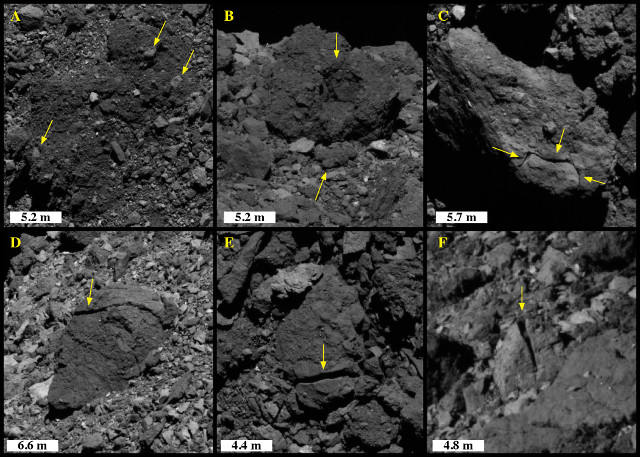
The disaggregation (top row) and linear fractures (bottom row) in rocks on asteroid Bennu

An article published in the journal “Nature Communications” reports the evidence of thermal fractures on asteroid Bennu caused by the temperature difference between day and night. A team of researchers led by Jamie Molaro of the Planetary Science Institute in Tucson, Arizona, examined images of Bennu’s surface captured by NASA’s OSIRIS-REx space probe, and found examples of this phenomenon. It’s the first detection of this phenomenon on an object without an atmosphere, and this offers new information to understand the evolution of Bennu and in general of asteroids over time. That includes the progressive disaggregation of rocks through the particular effect of thermal fracturing called exfoliation.

Ascuris Planum seen by Mars Express

ESA has published photos of the plateau called Ascuris Planum on the planet Mars captured by the Mars Express space probe’s High Resolution Stereo Camera (HRSC). The landscape is full of fractures, deep scars generated by intense and prolonged tectonic forces that acted on the red planet for hundreds of millions of years. Those fractures are the extensions of the troughs existing in the area called Tempe Fossae, in the region called Tempe Terra, north-east of the vast region of Tharsis, where in ancient times active volcanoes generated enormous stress in the Martian crust and consequently the tectonic horst and graben visible today.

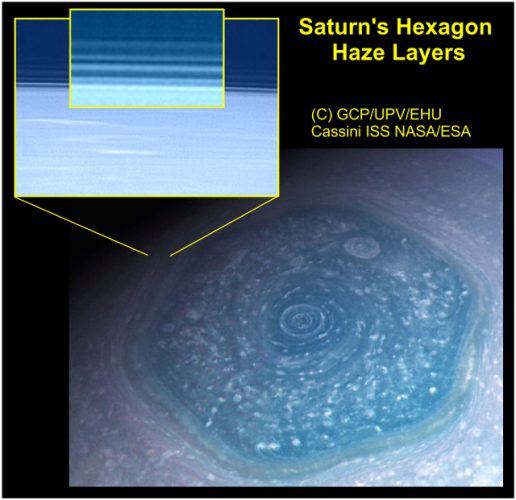
Saturn's hexagon and its layers

An article published in the journal “Nature Communications” reports a study on the stratification of the hexagonal structure of the gigantic hurricane that occupies the planet Saturn’s north pole. A team of researchers led by Professor Agustín Sánchez-Lavega of the University of the Basque Country used data collected by the Cassini space probe and the Hubble space telescope to understand that it’s a system composed of at least seven layers of haze with an extension of over 300 kilometers. The study also allowed to discover that those layers contain microscopic frozen particles composed of hydrocarbons such as acetylene, propane, propine, diacetylene, and butane.

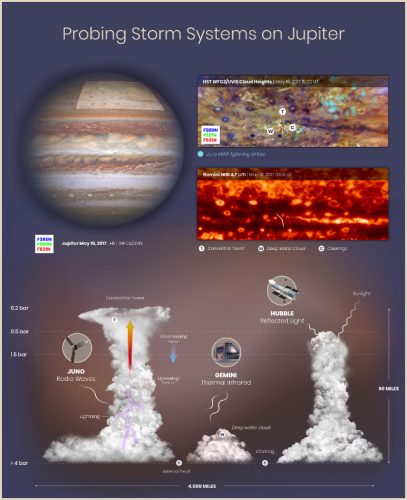
A graphic of the combined observations of Jupiter

An article published in “The Astrophysical Journal Supplement Series” reports the results of a series of combined observations of the planet Jupiter. A team of researchers led by Michael Wong of the University of California, Berkeley, used data collected by the Hubble Space Telescope, the Gemini Observatory in Hawaii and NASA’s Juno space probe to obtain a broader picture of various phenomena taking place in Jupiter’s atmosphere. Storms include the Great Red Spot, which the combined observations help us understand better.