Space Probes

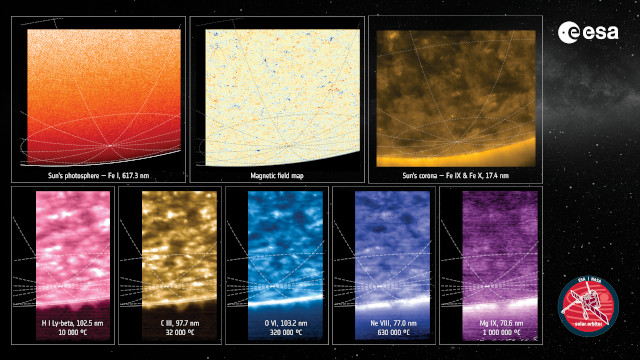
The Sun observed across eight different wavelengths by the Solar Orbiter space probe

ESA has released the first information, including the first images, of the Sun’s South Pole, captured between March 16 and 17, 2025, by the Solar Orbiter space probe, a mission operated in collaboration with NASA. Three of the scientific instruments on board made it possible to observe that area in different electromagnetic bands: Polarimetric and Helioseismic Imager (PHI), Extreme Ultraviolet Imager (EUI), and Spectral Imaging of the Coronal Environment (SPICE). The Sun’s poles aren’t visible from Earth, and Solar Orbiter is observing them as never before. The first observations have already revealed some surprises.


The Tianwen-2 space probe blasting off atop a Long March 3B rocket (Photo courtesy Xinhua/Cai Yang)

A few hours ago, the Tianwen-2 mission was successfully launched. A Long March 3B rocket blasted off from the Xichang Satellite Launch Center, and after about 18 minutes, the space probe separated from the rocket’s last stage to begin its journey towards the asteroid 469219 Kamoʻoalewa. The goal is to collect samples from its surface to bring back to Earth and then resume its journey in space towards the comet 311P/PanSTARRS.

The Magellanic Clouds as seen by the Gaia space probe (Image ESA)

An article published in “The Astrophysical Journal Letters” reports the results of a study of the Small Magellanic Cloud that shows how this dwarf galaxy is undergoing distortions in its shape due to various gravitational influences. Satoya Nakano and Kengo Tachihara of Nagoya University, Japan, used data collected by ESA’s Gaia space probe together with information on Cepheid stars collected by the OGLE (Optical Gravitational Lensing Experiment) project. This allowed them to determine the distances of 4,236 Cepheids and the anomalies in their motions. The conclusion is that the Small Magellanic Cloud is undergoing a gravitational influence from the Large Magellanic Cloud and another as yet unknown source.

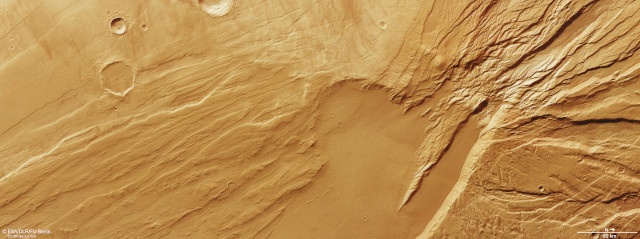
The area around the Acheron Fossae region on Mars

ESA has released images of the Acheron Fossae region on Mars captured by its Mars Express space probe’s High Resolution Stereo Camera (HRSC). The peculiarity of these images is that they show the two faces of Mars, meaning that they show how the red planet is basically divided into two parts with very different geological characteristics. About half of Mars is composed of an ancient terrain marked by craters and other signs of age and activity, while the other half is much smoother, with a surface probably reshaped by lava from volcanoes that are no longer active.

A sample from asteroid Bennu (Photo courtesy Yasuhiro Oba)

Two articles, one published in the journal “Nature” and one in “Nature Astronomy” report the results of examinations of samples from asteroid Bennu with the discovery of the presence of all the DNA and RNA bases and 14 of the 20 amino acids present on Earth. Two teams of researchers analyzed these samples, which were collected by NASA’s OSIRIS-REx space probe, which brought them back to Earth. Building blocks of life were also found in samples from the asteroid Ryugu brought back to Earth by the Hayabusa 2 space probe and the ones found in the samples brought back from Bennu offer new confirmation that the Earth may have been “seeded” by asteroids.